

Pass PMI-RMP Exam in First Attempt Guaranteed 100% Cover Real Exam Questions [Apr-2026]
Valid PMI-RMP test answers & PMI PMI-RMP exam pdf
NEW QUESTION # 52
A six-month, US$1,2 million project is two months completed. The project has 3 high, 6 medium, and 2 low risks, with a 10% reserve for known risks, and a 5% reserve for unknown risks. Most of the project's reserves have not been spent. The risk manager, who is also the project schedule manager, establishes monthly risk management reviews to evaluate performance. So far, the project has missed 50% of the planned risk mitigation milestones.
Based on this project data, what technique should the risk manager recommend to improve the risk management process?
- A. Increase the frequency of risk status meetings and update the risk management plan.
- B. Adjust project risk thresholds to increase the number of residual risks on the project.
- C. Increase the risk manager's position to a full-time position and acquire a dedicated project schedule lead.
- D. Perform a variance analysis and potentially allocate more reserves to improve risk mitigation.
Answer: C
NEW QUESTION # 53
The risk manager also serves as a facilitator for a project and realizes the project team members have biases impacting how they perceive risks. What analysis is currently being used?
- A. Qualitative risk analysis
- B. Quantitative risk analysis
- C. Stakeholder analysis
- D. Force field analysis
Answer: A
Explanation:
The analysis currently being used is qualitative risk analysis. Qualitative risk analysis involves assessing risks based on their likelihood of occurrence and their potential impact on the project. This type of analysis can help identify biases that may be impacting how team members perceive risks.
Qualitative risk analysis is the process of prioritizing individual project risks for further analysis or action by assessing their probability of occurrence and impact as well as other characteristics. Qualitative risk analysis helps to identify the most significant risks that require attention and response planning. One of the tools and techniques used in qualitative risk analysis is risk data quality assessment, which evaluates the degree to which the data about individual project risks is useful for risk management. Risk data quality assessment considers various aspects of data quality, such as reliability, accuracy, integrity, precision, and bias. Bias is the tendency of human judgment to be influenced by personal or organizational preferences, assumptions, beliefs, or emotions, rather than by objective facts or evidence. Bias can affect how project team members perceive and assess risks, leading to inaccurate or incomplete risk analysis results. Therefore, the risk manager who realizes the project team members have biases impacting how they perceive risks is currently using qualitative risk analysis to prioritize the risks and assess the quality of risk data. Reference: PMI, Practice Standard for Project Risk Management, 2009, p. 37-38, 41-42.
NEW QUESTION # 54
A risk management professional is currently facilitating the risk planning process with the project team. To increase the breadth of considered risks, the team wants to include high-level and strategic project risks.
What should the risk management professional do next?
- A. Perform a base line Monte Carlo simulation to address overall threats to project objectives
- B. Perform a sensitivity analysis to the higher-level aggregate activities
- C. Conduct a strengths, weaknesses, opportunities, and threats (SWOT) analysis
- D. Develop a risk breakdown structure (RBS) identifying the potential risk categories
Answer: C
Explanation:
A SWOT analysis is a risk identification technique that helps to identify high-level and strategic project risks by examining the internal and external factors that may affect the project objectives. A SWOT analysis involves listing the strengths, weaknesses, opportunities, and threats of the project, and then analyzing how they may impact the project positively or negatively. A SWOT analysis can help to uncover potential risks that may not be obvious from other techniques, such as prompt lists, interviews, or brainstorming12 References: 1: PMI Risk Management Professional (PMI-RMP)® Handbook, page 10 2: AGuide to the Project Management Body of Knowledge (PMBOK® Guide) - Seventh Edition, page 11.2.2.1
NEW QUESTION # 55
The project enters a testing phase to validate a project requirement. The testing is occurring in a common company testing area maintained by operations. The project team accepts the external customer's additional testing requirements, which may cause a slip in the schedule. A risk is identified, added to the risk register, and a response is developed.
What is the next step to be completed?
- A. Hire more resources to ensure the original schedule is maintained.
- B. Inform the external customer that the project manager has added the schedule risk to the register.
- C. Resist the customer's scope increase to maintain the original testing requirements.
- D. Communicate and monitor the risk response with testing and operations.
Answer: D
NEW QUESTION # 56
Some engineers are completing an activity that will alert the project team if there is a risk of requiring additional effort to complete the project. What should the risk manager do in case the trigger arises?
- A. Add the alert to the risk register.
- B. Activate the contingency plan.
- C. Request a reserves increase.
- D. Update the risk response plan.
Answer: B
Explanation:
A contingency plan is pre-planned for specific risk triggers. When the trigger is observed, the contingency plan should be activated as specified. PMBOK Guide states:
"If a risk trigger occurs, the corresponding contingency plan or fallback plan should be implemented as documented in the risk response plan."
- PMBOK Guide, 6th Edition, Section 11.6
References:
PMBOK Guide, 6th Edition, Section 11.6
NEW QUESTION # 57
An agriculture government agency faces different challenges with farmers and landlords In implementing its ambitious growth strategy. The agency decided to establish an enterprise risk management unit to identify risks, analyze risks, and provide a handbook showing how to handle the surrounding uncertainty.
What should the risk management expert recommend the agency do first to identify risks and develop the handbook?
- A. Follow standard risk Identification tools dedicated for agriculture and tailor them to the environment.
- B. Hire an agriculture expert who can develop the required handbook and discuss it with the agriculture minister.
- C. Prepare a list of the key resources that will be used to compile a risk management plan.
- D. Conduct meetings, facilitated workshops, and interviews with stakeholders to identify potential risks.
Answer: D
Explanation:
According to the PMBOKGuide1, risk identification is the process of determining which risks may affect the project and documenting their characteristics. It involves the use of various techniques to gather information from different sources and perspectives, such as stakeholders, experts, historical data, assumptions, and environmental factors. Some of the common techniques for risk identification are meetings, facilitated workshops, interviews, brainstorming, checklists, questionnaires, SWOT analysis, and root cause analysis. These techniques help to elicit the knowledge and opinions of the participants, and to generate a comprehensive list of potential risks that can be further analyzed and prioritized. In this case, the risk management expert should recommend the agency to conduct meetings, facilitated workshops, and interviews with stakeholders to identify potential risks and develop the handbook. This will help to understand the context and objectives of the agency, the expectations and concerns of the farmers and landlords, the challenges and opportunities in the agriculture sector, and the possible sources and impacts of uncertainty. The risk management expert can then use the information gathered from these techniques to create a risk register and a risk management plan, which can form the basis of the handbook. This is part of the Identify Risks process in the PMBOKGuide1. Reference: 1: A Guide to the Project Management Body of Knowledge (PMBOKGuide) - Sixth Edition Engaging stakeholders through meetings, workshops, and interviews is crucial for risk identification, as it allows the agency to gather diverse perspectives and insights on potential risks. This approach is more effective than relying solely on standard tools or hiring an expert.
NEW QUESTION # 58
Lisa is the project manager of the FKN project for her organization. She is working with Sam, the CIO, to discuss a discount the vendor has offered the project based on the amount of materials that is ordered. Lisa and Sam review the offer and agree that while their project may qualify for the discounted materials the savings is nominal and they would not necessarily pursue the savings. Lisa documents this positive risk response in the risk register. What risk response is this?
- A. Acceptance
- B. Transference
- C. Share
- D. Enhance
Answer: A
Explanation:
Explanation/Reference:
NEW QUESTION # 59
You are the project manager of a large, high-profile project in your organization. You have realized that politics within your company may affect the true identification of risk events within the project. You decide that you'd like to use a method to identify risk events through an anonymous process. Which one of the following risk events will allow you to collect and distribute risk information without the stakeholders knowing what other stakeholders are communicating about the project risk events?
- A. Surveys
- B. Checklist analysis
- C. Monte Carlo Technique
- D. Delphi Technique
Answer: D
NEW QUESTION # 60
A project manager is assigned to a new project and is told they need to develop the project's risk register. When should the project manager identify the project risks?
- A. Ensure project team members proactively identify risks throughout the project to plan for possible response strategies
- B. Delegate risk identification to each team member and have them record the risks on separate risk registers for their areas
- C. Identify risks only at the project's midpoint for the stakeholders to review them
- D. Identify risks at the beginning of the project because the risk posture will not change
Answer: A
Explanation:
Risk identification should be an ongoing process throughout the project lifecycle. Encouraging project team members to proactively identify risks allows for continuous risk management and the development of appropriate response strategies as new risks emerge.
According to the PMI Risk Management Professional (PMI-RMP)Examination Content Outline1, one of the tasks in the domain of Risk Identification is to ensure that project team members proactively identify risks throughout the project life cycle, using various tools and techniques, to enable planning for possible risk response strategies1. Risk identification is an iterative process that should be performed regularly and frequently throughout the project, as new risks may emerge or existing risks may change due to internal or external factors2. The project manager should involve the project team members and other relevant stakeholders in the risk identification process, as they may have different perspectives, expertise, and insights on the project risks3. The project manager should not identify risks only at the project's midpoint for the stakeholders to review them, because that would be too late and ineffective to manage the risks that may have already occurred or escalated4. The project manager should not identify risks at the beginning of the project because the risk posture will not change, because that would be unrealistic and imprudent to assume that the project environment and conditions will remain static and predictable5. The project manager should not delegate risk identification to each team member and have them record the risks on separate risk registers for their areas, because that would create inconsistency, duplication, and fragmentation of the risk information, and prevent a holistic and integrated view of the project risks. Reference: 1: PMI Risk Management Professional (PMI-RMP)Examination Content Outline, page 82: A Guide to the Project Management Body of Knowledge (PMBOKGuide) - Sixth Edition, page 3983: A Guide to the Project Management Body of Knowledge (PMBOKGuide) - Sixth Edition, page 3994: Risk Identification: When and How Often to Do It During the Project Life Cycle5: Risk Management: Why Is It Important?. : Risk Register in Project Management - Project Management Academy.
NEW QUESTION # 61
A risk management professional is currently facilitating the risk planning process with the project team. To increase the breadth of considered risks, the team wants to include high-level and strategic project risks.
What should the risk management professional do next?
- A. Perform a sensitivity analysis to the higher-level aggregate activities
- B. Conduct a strengths, weaknesses, opportunities, and threats (SWOT) analysis
- C. Develop a risk breakdown structure (RBS) identifying the potential risk categories
- D. Perform a base line Monte Carlo simul-ation to address overall threats to project objectives
Answer: B
Explanation:
A SWOT analysis is a risk identification technique that helps to identify high-level and strategic project risks by examining the internal and external factors that may affect the project objectives. A SWOT analysis involves listing the strengths, weaknesses, opportunities, and threats of the project, and then analyzing how they may impact the project positively or negatively. A SWOT analysis can help to uncover potential risks that may not be obvious from other techniques, such as prompt lists, interviews, or brainstorming12
1: PMI Risk Management Professional (PMI-RMP) Handbook, page 10 2: A Guide to the Project Management Body of Knowledge (PMBOK Guide) - Seventh Edition, page 11.2.2.1
NEW QUESTION # 62
You are the project manager of the NHH project for your company. You and the project team have completed the quantitative risk analysis for your project. During this process you create a contingency reserve based on the risk probability-impact matrix as seen in the figure below.
Based on the information in the figure above, what amount would you need to include in your risk contingency fund?
- A. -$465,000
- B. $171,500
- C. -$258,500
- D. $258,500
Answer: D
NEW QUESTION # 63
A home solar panel project has many internal and external stakeholders including households, businesses, community groups, electric utility companies, local government officials, landlords, and investors. What should the project manager do when engaging stakeholders?
- A. Ignore any risks beyond stakeholders' tolerance.
- B. Communicate response strategies to all stakeholders.
- C. Consider stakeholders' positions and opinions regarding the project's output.
- D. Include all stakeholders in the project's governance.
Answer: C
Explanation:
The project manager should consider stakeholders' positions and opinions regarding the project's output when engaging stakeholders. This approach helps to address stakeholders' concerns, expectations, and potential objections, and it can lead to better decision-making and more successful project outcomes. It is important for the project manager to maintain open communication with stakeholders and to be responsive to their needs and perspectives.
According to the PMI Risk Management Professional (PMI-RMP)Examination Content Outline, one of the tasks under the domain of stakeholder engagement is to "engage stakeholders by communicating with them to understand their positions and opinions regarding the project's output, and to ensure that their interests are considered in the risk management process" (Task 1.3). This implies that the project manager should consider stakeholders' perspectives and expectations when engaging them, and not ignore, exclude, or impose on them. Therefore, option D is the correct answer.
Option A is incorrect because not all stakeholders need to be involved in the project's governance, which is the set of policies, processes, and procedures that define how the project is managed and controlled. The project's governance should be determined by the project sponsor and the project management office (PMO), and only include those stakeholders who have authority and responsibility for the project's success.
Option B is incorrect because communicating response strategies to all stakeholders is not a stakeholder engagement activity, but a risk communication activity. The project manager should communicate response strategies to the relevant stakeholders who are assigned to implement or monitor them, and not to all stakeholders indiscriminately.
Option C is incorrect because ignoring any risks beyond stakeholders' tolerance is not a stakeholder engagement activity, but a risk attitude activity. The project manager should identify and assess all risks that may affect the project's objectives, regardless of stakeholders' tolerance levels. The project manager should also consult with stakeholders to determine their risk appetite, threshold, and attitude, and use this information to prioritize and respond to risks accordingly.
NEW QUESTION # 64
You are the project manager of the NHH project for your company. You and the project team have completed the quantitative risk analysis for your project. During this process you create a contingency reserve based on the risk probability-impact matrix as seen in the figure below.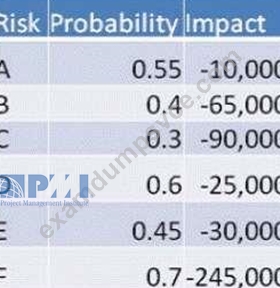
Based on the information in the figure above, what amount would you need to include in your risk contingency fund?
- A. -$465,000
- B. $171,500
- C. -$258,500
- D. $258,500
Answer: D
NEW QUESTION # 65
A project team has completed the risk identification steps in a project and compiled a list of 25 risks. The team wants to create response plans for all the risks to avoid any future issues, but the resources and constraints limit the options.
What should the risk manager do?
- A. Perform a qualitative risk analysis.
- B. Perform a sensitivity analysis.
- C. Perform a root-cause analysis.
- D. Perform a constraint analysis.
Answer: A
NEW QUESTION # 66
A risk management professional is in the process of categorizing risks when a subject matter expert (SME) suggests categorizing the risks by their impact to the project objectives. Why should the risk management professional use this approach?
- A. To enable the team in identifying the specific causes of risks associated with project objectives.
- B. To determine there more attentive project leadership and organizational involvement is needed.
- C. To assign risks and risk severities to functional discipline and departments effectively.
- D. To ensure that project priorities are being appropriately factored into risk response plans.
Answer: D
Explanation:
Categorizing risks by their impact on project objectives ensures that risk response plans are aligned with project priorities. This helps in focusing on the most critical risks and their potential impact on the project's success.
Categorizing risks by their impact to the project objectives is a way of aligning the risk management process with the project goals and stakeholder expectations. By doing so, the risk management professional can ensure that the risk response plans are focused on the most critical aspects of the project and that the project priorities are being considered in the decision making. This approach can also help to communicate the value of risk management to the project team and the stakeholders, as they can see how the risk management activities are contributing to the project success. Categorizing risks by their impact to the project objectives does not necessarily help to identify the specific causes of risks, determine the level of project leadership and organizational involvement, or assign risks and risk severities to functional disciplines and departments. These are other possible ways of categorizing risks, but they are not the main purpose of using the impact to the project objectives approach. References: PMI-RMP Certification Handbook1, page 9; PMBOK Guide, page 415.
NEW QUESTION # 67
While implementing the risk response plan for a previously identified risk, some secondary risks were identified but not captured on the risk register. The project manager decided to review the risk management plan to ensure this does not happen for future, similar situations.
What should the project manager do next?
- A. Monitor and control secondary and residual risks in the risk register.
- B. Develop risk response plans for all identified risks.
- C. Identify secondary or residual risks for associated risk plans.
- D. Update the communications management plan to avoid future issues
Answer: C
Explanation:
The project manager should monitor and control secondary and residual risks in the risk register. This will ensure that any new risks identified during the implementation of the risk response plan are captured and managed effectively. Monitoring and controlling risks is a continuous process that helps in identifying, analyzing, and planning for new risks as well as updating the risk register as needed.
According to the PMI Risk Management Professional (PMI-RMP)®Examination Content Outline, one of the tasks under the domain of Risk Response Planning is to "identify and assess the effectiveness of alternative strategies to reduce threats or enhance opportunities, such as mitigation, transference, avoidance, and acceptance" 1. This implies that the project manager should also consider the potential secondary or residual risks that may arise from implementing the chosen risk response strategy. Secondary risks are new risks that are created as a direct result of implementing a risk response, while residual risks are those that remain after therisk response has been executed 2. Both types of risks should be identified and assessed for their impact and probability, and added to the risk register for further monitoring and control. Therefore, the correct answer is A.
References: 1: PMI Risk Management Professional (PMI-RMP)® Examination Content Outline, page 91 2:
A Guide to the Project Management Body of Knowledge (PMBOK® Guide) - Sixth Edition, page 4362
NEW QUESTION # 68
Eric is the project manager of the MTC project for his company. In this project a vendor has offered Eric a sizeable discount on all hardware if his order total for the project is more than
$125,000. Right now, Eric is likely to spend $118,000 with vendor. If Eric spends $7,000 his cost savings for the project will be $12,500, but he cannot purchase hardware if he cannot implement the hardware immediately due to organizational policies. Eric consults with Amy and Allen, other project managers in the organization, and asks if she needs any hardware for their projects. Both Amy and Allen need hardware and they agree to purchase the hardware through Eric's relationship with the vendor. What positive risk response has happened in this instance?
- A. Exploiting
- B. Transference
- C. Sharing
- D. Enhancing
Answer: C
NEW QUESTION # 69
A risk manager is conducting a risk audit review at project completion. Which of the following represents the order that the steps should be performed to complete the full risk audit review?
- A. Arrange risk audit review, identify participants, prepare recommendations, update risk management plan
- B. Prepare recommendations, identify participants, conduct risk audit reviews, document the risk audit report
- C. Identify participants, conduct risk audit reviews, prepare recommendations, document the risk audit report
- D. Identify participants, conduct risk meeting, document findings, update risk management plan
Answer: D
NEW QUESTION # 70
The trigger for a highly categorized threat has occurred. The risk has a set response plan.
Who is responsible for developing responses to risk and monitoring the implementation status of the risk response?
- A. Product Manager
- B. Risk Owner
- C. Project Manager
- D. Risk Action Owner
Answer: B
NEW QUESTION # 71
During the monthly executive review meeting, the project sponsor would like to understand how the project team has planned to manage risks that were identified in the last meeting. What should the project manager do?
- A. Transfer secondary and residual risks to the project sponsor.
- B. Utilize a Monte Carlo assessment to provide risk related impacts.
- C. Include secondary and residual risks as part of the response.
- D. React to the secondary and residual risks only if they occur.
Answer: C
Explanation:
The The project manager should include secondary and residual risks as part of the risk response plan.
Secondary risks are those risks that arise as a direct result of implementing a risk response to a specific risk.
Residual risks are those risks that are expected to remain after the planned responses of risks have been taken, as well as those that have been deliberately accepted. Both secondary and residual risks should be identified, analyzed, and monitored throughout the project life cycle. The project manager should communicate the risk response plan to the project sponsor and other stakeholders, and explain how the project team has planned to manage the secondary and residual risks12 References: 1: PMI Risk Management Professional (PMI-RMP) Handbook, page 10 2: A Guide to the Project Management Body of Knowledge (PMBOK Guide) - Seventh Edition, page 11.2.2.1 project manager should include secondary and residual risks in the risk response plan, as they may still impact the project. Proactively addressing these risks will help the project team to be prepared and manage them effectively if they occur.
NEW QUESTION # 72
Billy is the project manager of the HAR Project and is in month six of the project. The project is scheduled to last for 18 months. Management asks Billy how often the project team is participating in risk reassessment in this project. What should Billy tell management if he's following the best practices for risk management?
- A. Project risk management happens at every milestone.
- B. Project risk management has been concluded with the project planning.
- C. At every status meeting the project team project risk management is an agenda item.
- D. Project risk management is scheduled for every month in the 18-month project.
Answer: C
NEW QUESTION # 73
What is risk tolerance?
- A. Ability to manage risks
- B. Ability to mitigate risks
- C. Willingness to accept varying degrees of risks
- D. Willingness to develop a risk management plan
Answer: C
NEW QUESTION # 74
Your project is an agricultural-based project that deals with plant irrigation systems. You have discovered a byproduct in your project that your organization could use to make a profit. If your organization seizes this opportunity it would be an example of what risk response?
- A. Exploiting
- B. Opportunistic
- C. Positive
- D. Enhancing
Answer: A
NEW QUESTION # 75
The project manager for project X was expecting the mobilization of critical equipment from another project, project Y. However, a day before the mobilization was scheduled, another project manager notifies project X's project manager that the equipment would not be available for at least another month due to delayed activities for project Y. This has jeopardized meeting a critical milestone for project X.
How should project X's project manager avoid this situation in the future?
- A. Request that the other project manager be added to relevant reports
- B. Ask the other project manager to officially confirm the new date in writing
- C. Prepare a contingency response plan to implement when delays occur
- D. Request that the other project manager inform if any additional delays are expected
Answer: C
Explanation:
A contingency response plan helps the project manager to be prepared for unexpected situations, such as delays in equipment mobilization. This plan should outline alternative actions to take in case of such delays, minimizing the impact on the project.
According to the PMBOKGuide, a contingency response plan is a predefined action that the project team will take if an identified risk event occurs. It is part of the risk response plan, which is the output of the Plan Risk Responses process. The contingency response plan helps the project team to reduce the impact of the risk event on the project objectives, such as scope, schedule, cost, and quality. The contingency response plan should be documented in the risk register, along with the risk triggers, the assigned risk owners, and the allocated contingency reserves.
The project manager for project X should prepare a contingency response plan to avoid the situation of being dependent on the availability of critical equipment from another project, project Y. This is because the equipment mobilization is an external dependency, which is a type of inter-project dependency that occurs when a project relies on another project for a deliverable or resource. Inter-project dependencies are a source of risk for the project, as they may cause delays, conflicts, or changes in the project scope or quality. The project manager should identify, analyze, and monitor the inter-project dependencies, and plan appropriate risk responses to deal with them.
The contingency response plan for the equipment mobilization could include alternative sources of equipment, such as renting, purchasing, or borrowing from other projects or vendors. The contingency response plan could also include schedule adjustments, such as fast-tracking, crashing, or re-sequencing the activities that require the equipment. The contingency response plan should be implemented when the risk trigger occurs, such as the notification of the delay from the other project manager. The project manager should also communicate the contingency response plan to the relevant stakeholders, such as the project sponsor, customer, team members, and other project managers.
The other options are not valid for avoiding the situation in the future:
Ask the other project manager to officially confirm the new date in writing: This is not a valid option because it does not address the root cause of the problem, which is the dependency on the equipment from another project. Asking for a confirmation in writing may help to document the issue and track the progress, but it does not prevent the situation from happening again. The project manager should plan for the possibility of delays or changes in the equipment availability, and not rely on the other project manager's promises or commitments.
Request that the other project manager be added to relevant reports: This is not a valid option because it does not address the root cause of the problem, which is the dependency on the equipment from another project. Adding the other project manager to the relevant reports may help to improve the communication and coordination between the projects, but it does not prevent the situation from happening again. The project manager should plan for the possibility of delays or changes in the equipment availability, and not rely on the other project manager's information or updates.
Request that the other project manager inform if any additional delays are expected: This is not a valid option because it does not address the root cause of the problem, which is the dependency on the equipment from another project. Requesting the other project manager to inform if any additional delays are expected may help to anticipate and prepare for the impact, but it does not prevent the situation from happening again. The project manager should plan for the possibility of delays or changes in the equipment availability, and not rely on the other project manager's forecasts or estimates.
NEW QUESTION # 76
......
PMI-RMP Exam Questions – Valid PMI-RMP Dumps Pdf: https://www.examdumpsvce.com/PMI-RMP-valid-exam-dumps.html
Verified PMI-RMP dumps Q&As - Pass Guarantee: https://drive.google.com/open?id=1tRX5ty-qqXOkCg0s3Zb2AsW3MMuR9XeC
