

Verified Salesforce-MuleSoft-Developer-II Dumps Q&As - Salesforce-MuleSoft-Developer-II Test Engine with Correct Answers
Pass Your Salesforce-MuleSoft-Developer-II Dumps as PDF Updated on 2026 With 62 Questions
Salesforce Salesforce-MuleSoft-Developer-II Exam Syllabus Topics:
| Topic | Details |
|---|---|
| Topic 1 |
|
| Topic 2 |
|
| Topic 3 |
|
| Topic 4 |
|
| Topic 5 |
|
NEW QUESTION # 17
Refer to the exhibits.
Bioinfo System API is implemented and published to Anypoint Exchange. A developer wants to invoke this API using its REST Connector.
What should be added to the POM?
- A.

- B.

- C.
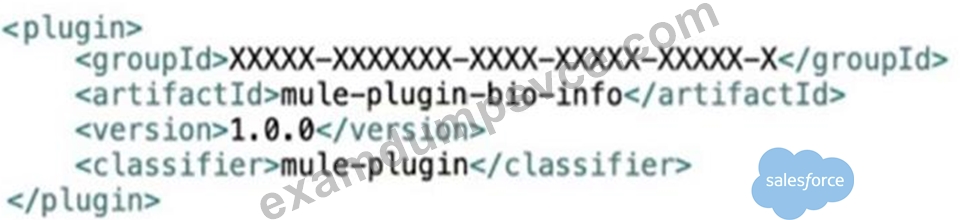
- D.

- E.

Answer: C
Explanation:
To invoke Bioinfo System API using its REST Connector, option E should be added to the pom.xml file. This option adds a dependency for Bioinfo System API REST Connector with its group ID, artifact ID, version, classifier, and type. The classifier specifies that it is a REST Connector (raml-client), and the type specifies that it is a Mule plugin (mule-plugin). Reference: https://docs.mulesoft.com/apikit/4.x/apikit-4-generate-from-rest-api-task#add-the-api-dependency-to-the-pom-file
NEW QUESTION # 18
An organization uses CloudHub to deploy all of its applications.
How can a common-global-handler flow be configured so that it can be reused across all of the organization's deployed applications?
- A. Create a Mule Plugin project
- B. Create a Mule plugin project
Create a common-global-error-handler flow inside the plugin project.
Use this plugin as a dependency in all Mute applications.
Import that configuration file in Mute applications. - C. Create a common-global-error-handler flow in all Mule Applications Refer to it flow-ref wherever needed.
Answer: A
Explanation:
Create a common-global-error-handler flow inside the plugin project.
Use this plugin as a dependency in all Mule applications
D.
Create a Mule daman project.
Create a common-global-error-handler flow inside the domain project.
Use this domain project as a dependency.
Explanation:
To configure a common-global-handler flow that can be reused across all of the organization's deployed applications, the developer should create a Mule Plugin project, create a common-global-error-handler flow inside the plugin project, and use this plugin as a dependency in all Mule applications. This way, the developer can import the common-global-error-handler flow in any application that needs it and avoid duplicating the error handling logic. Reference: https://docs.mulesoft.com/mule-runtime/4.3/error-handling#global-error-handler
NEW QUESTION # 19
A Mule implementation uses a HTTP Request within an Unit Successful scope to connect to an API.
How should a permanent error response like HTTP:UNAUTHORIZED be handle inside Until Successful to reduce latency?
- A. Configure retrying until a MULERETRY_EXHAUSTED error is raised or the API responds back with a successful response.
- B. Put the HTTP Request inside a try scope in Unit Successful.
In the error handler, use On Error Propagate to catch permanent errors like HTTP UNAUTHORIZED. - C. Put the HTTP Request inside a try scope in Unit Successful.
In the error handler, use On Error Continue to catch permanent errors like HTTP UNAUTHORIZED. - D. In Until Successful configuration, set the retry count to 1 for error type HTTP: UNAUTHORIZED.
Answer: C
Explanation:
To handle a permanent error response like HTTP:UNAUTHORIZED inside Until Successful, the developer should put the HTTP Request inside a try scope in Unit Successful, and use On Error Continue to catch permanent errors like HTTP UNAUTHORIZED in the error handler. This way, the developer can avoid retrying requests that will always fail due to a permanent error, and reduce latency. On Error Continue allows the flow to continue processing after handling the error. Reference: https://docs.mulesoft.com/mule-runtime/4.3/until-successful-scope https://docs.mulesoft.com/mule-runtime/4.3/on-error-continue-concept
NEW QUESTION # 20
Refer to the exhibit.
A Mute Object Store is configured with an entry TTL of one second and an expiration interval of 30 seconds.
What is the result of the flow if processing between os'store and os:retrieve takes 10 seconds?
- A. nullPayload
- B. originalPayload
- C. testPayload
- D. OS:KEY_NOT_FOUND
Answer: A
Explanation:
The result of the flow is nullPayload if processing between os:store and os:retrieve takes 10 seconds. This is because the entry TTL of the object store is one second, which means that any stored value expires after one second and is removed from the object store. The expiration interval of 30 seconds only determines how often the object store checks for expired values, but it does not affect the TTL. Therefore, when os:retrieve tries to get the value after 10 seconds, it returns nullPayload because the value has already expired and been removed. Reference: https://docs.mulesoft.com/object-store/osv2-faq#how-does-the-time-to-live-work
NEW QUESTION # 21
A developer deploys an API to CloudHub and applies an OAuth policy on API Manager. During testing, the API response is slow, so the developer reconfigures the API so that the out-of-the-box HTTP Caching policy is applied first, and the OAuth API policy is applied second.
What will happen when an HTTP request is received?
- A. In case of a cache hit, both the OAuth and HTTP Caching policies are evaluated; then the cached response is returned to the caller
- B. In case of a cache it, only the HTTP Caching policy is evaluating; then the cached response is returned to the caller
- C. In case of a cache miss, only the HTTP Caching policy is evaluated; then the API retrieves the data from the API implementation, and the policy stores the data to be cached in Object Store
- D. In case of a cache miss, both the OAuth and HTTP Caching policies are evaluated; then the API retrieves the data from the API implementation, and the policy does not store the data in Object Store
Answer: B
Explanation:
When an HTTP request is received and the HTTP Caching policy is applied first, it checks if there is a cached response for that request in Object Store. If there is a cache hit, meaning that a valid cached response exists, then only the HTTP Caching policy is evaluated and the cached response is returned to the caller without invoking the OAuth policy or the API implementation. If there is a cache miss, meaning that no valid cached response exists, then both the HTTP Caching policy and the OAuth policy are evaluated before invoking the API implementation. Reference: https://docs.mulesoft.com/api-manager/2.x/http-caching-policy#policy-ordering
NEW QUESTION # 22
A Mule application defines as SSL/TLS keystore properly 'tis,keystore.keyPassword'' as secure.
How can this property be referenced to access its value within the application?
- A. ${secure::tiskeystore,keyPassowrd}
- B. ${secure::tiskeystore,keyPassowrd}
- C. p{secure::tiskeystore,keyPassowrd}
- D. #{secure::tiskeystore,keyPassowrd}
Answer: B
Explanation:
secure::tiskeystore,keyPassowrd∗∗ShortExplanationofCorrectAnswerOnly:Toreferenceasecurepropertyvaluewithintheapplication,thedeveloperneedstousethesyntax{secure::}. In this case, the property name is tiskeystore,keyPassword, so the correct syntax is ${secure::tiskeystore,keyPassowrd}. Reference: https://docs.mulesoft.com/mule-runtime/4.3/secure-configuration-properties#referencing-secure-properties
NEW QUESTION # 23
A new Mule project has been created in Anypoint Studio with the default settings.
Which file inside the Mule project must be modified before using Maven to successfully deploy the application?
- A. Settings.xml
- B. Mule.artificact.json
- C. Config.yaml
- D. Pom.xml
Answer: D
Explanation:
To use Maven to successfully deploy the application, the developer needs to modify the pom.xml file inside the Mule project. The pom.xml file contains the configuration and dependencies of the Mule application, as well as the deployment information such as the CloudHub region, environment, and worker size. The developer needs to specify these properties in the pom.xml file before using Maven to deploy the application. Reference: https://docs.mulesoft.com/mule-runtime/4.3/mmp-concept#application-deployment-descriptor
NEW QUESTION # 24
When a client and server are exchanging messages during the mTLS handshake, what is being agreed on during the cipher suite exchange?
- A. The TLS version
- B. A protocol
- C. The Public key format
- D. An encryption algorithm
Answer: D
Explanation:
A cipher suite is a set of cryptographic algorithms that are used to secure the communication between a client and a server. A cipher suite consists of four components: a key exchange algorithm, an authentication algorithm, an encryption algorithm, and a message authentication code (MAC) algorithm. During the cipher suite exchange, the client and the server agree on which encryption algorithm to use for encrypting and decrypting the data. Reference: https://docs.mulesoft.com/mule-runtime/4.3/tls-configuration#cipher-suites
NEW QUESTION # 25
A scatter-gather router is configured with four routes:Route A, B, C and D.
Route C false.
- A. Payload ['2']
- B. Error,errorMesage.payload.results ['2']
- C. Error,errorMessage,payload.failures['2']
- D. Payload failures['2']
Answer: B
Explanation:
The result of accessing route C failure is Error,errorMessage,payload.failures['2']. This is because a scatter-gather router returns an aggregated message that contains an array of results from each route and an array of failures from each route. The failures array contains error objects with information about each failed route execution. To access route C failure, which is the third route (index 2), the developer needs to use Error.errorMessage.payload.failures['2'] expression. Reference: https://docs.mulesoft.com/mule-runtime/4.3/scatter-gather-reference#scatter-gather-output
NEW QUESTION # 26
A healthcare portal needs to validate the token that it sends to a Mule API. The developer plans to implement a custom policy using the HTTP Policy Transform Extension to match the token received in the header from the heathcare portal.
Which files does the developer need to create in order to package the custom policy?
- A. XML template file, YAML configuration file
- B. JSON properties file, XML template file
- C. JSON properties file, YAML configuration file
- D. Deployable ZIP file, YAML configuration file
Answer: A
Explanation:
To package a custom policy using the HTTP Policy Transform Extension, the developer needs to create an XML template file and a YAML configuration file. The XML template file defines the policy logic using Mule components and placeholders for user-defined properties. The YAML configuration file defines the metadata of the policy, such as its name, description, category, parameters, and dependencies. Reference: https://docs.mulesoft.com/api-manager/2.x/http-policy-transform#packaging-the-policy
NEW QUESTION # 27
Which configurations are required for HTTP Listener to enable mTLS authentication?
- A. Set an appropriate keystore and truststore configuration for the listener
- B. Set an appropriate keystore configuration and use persistent connections for the listener
- C. Set an appropriate truststore configuration and reconnection strategy for the listener
- D. Set an appropriate reconnection strategy and use persistent connections for the listener
Answer: A
Explanation:
To enable mTLS authentication for HTTP Listener, the developer needs to set an appropriate keystore and truststore configuration for the listener. The keystore contains the certificate and private key of the Mule application that are used to prove its identity to clients. The truststore contains the certificates of trusted clients that are allowed to access the Mule application. Reference: https://docs.mulesoft.com/mule-runtime/4.3/tls-configuration#mutual-authentication
NEW QUESTION # 28
Multiple individual Mute application need to use the Mule Maven plugin to deploy to CloudHub.
The plugin configuration should .. reused where necessary and anything project, specific should be property-based.
Where should the Mule Maven details be configured?
- A. Settings, xml
- B. A parent pom.xml
- C. Pom, xml
- D. A Bill of Materials (BOM) parent pm
Answer: B
Explanation:
To reuse Mule Maven plugin configuration across multiple individual Mule applications, the developer should use a parent pom.xml file. A parent pom.xml file defines common configuration for one or more child projects that inherit from it. The developer can specify common properties and dependencies for all child projects in the parent pom.xml file, such as Mule Maven plugin configuration, and then reference them in each child project's pom.xml file using placeholders. Reference: https://docs.mulesoft.com/mule-runtime/4.3/mmp-concept#parent-pom https://maven.apache.org/guides/introduction/introduction-to-the-pom.html#Project_Inheritance
NEW QUESTION # 29
A Mule application contain two policies Policy A and Policy A has order1, and Policy B has order 2. Policy A Policy B, and a flow are defined by he configuration below.
When a HTTP request arrives at the Mule application's endpoint, what will be the execution order?
- A. F1, A1, B1, B2, A2
- B. B1, A1, F1, A2, B2
- C. F1, B1, A1, A2, B2
- D. A1, B1, F1, B2, A2
Answer: D
Explanation:
Based on the configuration below, when a HTTP request arrives at the Mule application's endpoint, the execution order will be A1, B1, F1, B2, A2. This is because policies are executed before and after the API implementation flow according to their order attribute. Policy A has order 1, which means it is executed first before Policy B, which has order 2. The flow is executed after both policies are executed before the flow. Then, Policy B is executed after the flow before Policy A is executed after the flow. Reference: https://docs.mulesoft.com/api-manager/2.x/policies-policy-order
NEW QUESTION # 30
A company with MuleSoft Titanium develops a Salesforce System API using MuleSoft out-of-the-box Salesforce Connector and deploys the API to CloudHub.
Which steps provide the average number of requests and average response time of the Salesforce Connector?
- A. Access Anypoint Monitoring built-in dashboard.
Select a resource.
Locate the information under Log Manager < Raw Data. - B. Access Anypoint Monitoring's built-in dashboard
Seclect a resource.
Create a custom dashboard to retrieve the information. - C. Change the API Implementation to capture the information in the log.
Retrieve the information from the log file. - D. Access Anypoint Monitoring's built-in dashboard. Select a resource.
Locate the information under the Connectors tab.
Answer: D
Explanation:
To get the average number of requests and average response time of the Salesforce Connector, the developer should access Anypoint Monitoring's built-in dashboard, select a resource (such as an application or an API), and locate the information under the Connectors tab. The Connectors tab shows metrics for each connector used by the resource, such as average requests per minute, average response time, and failures. Reference: https://docs.mulesoft.com/monitoring/built-in-dashboard-reference
NEW QUESTION # 31
A company has been using CI/CD. Its developers use Maven to handle build and deployment activities.
What is the correct sequence of activities that takes place during the Maven build and deployment?
- A. Initialize, validate, compute, test, package, verify, install, deploy
- B. Validation, initialize, compile, test, package, install verify, deploy
- C. Validate, initialize, compile, package, test, install, verify, verify, deploy
- D. Validate, initialize, compile, test package, verify, install, deploy
Answer: D
Explanation:
The correct sequence of activities that takes place during the Maven build and deployment is validate, initialize, compile, test package, verify, install, deploy. These are Maven lifecycle phases that define a sequence of goals to execute during a build process. Each phase represents a stage in the build lifecycle and can have zero or more goals bound to it. Reference: https://maven.apache.org/guides/introduction/introduction-to-the-lifecycle.html
NEW QUESTION # 32
Which type of cache invalidation does the Cache scope support without having to write any additional code?
- A. Time to live
- B. White-behind invalidation
- C. Write-through invalidation
- D. Notification-based invalidation
Answer: A
Explanation:
The Cache scope supports time to live (TTL) as a cache invalidation strategy without having to write any additional code. TTL specifies how long the cached response is valid before it expires and needs to be refreshed. The Cache scope also supports custom invalidation strategies using MEL or DataWeave expressions. Reference: https://docs.mulesoft.com/mule-runtime/4.3/cache-scope#cache_invalidation
NEW QUESTION # 33
Which statement is true when working with correlation IDS?
- A. The Anypoint MQ Connector automatically propagates correlation IDS
- B. The HTTP Listener regenerates correlation IDs regardless of the HTTP request
- C. The VM Connector does not automatically propagate correction IDs
- D. The HTTP Listener generates correlation IDS unless a correlation ID is received in the HTTP request
Answer: D
Explanation:
When working with correlation IDs, the HTTP Listener generates correlation IDs unless a correlation ID is received in the HTTP request. In that case, it propagates the received correlation ID throughout the flow execution. Correlation IDs are used to track events across different flows or applications. Reference: https://docs.mulesoft.com/mule-runtime/4.3/about-mule-message#message-attributes
NEW QUESTION # 34
A Mule application for processing orders must log the order ID for every log message output.
What is a best practice to enrich every log message with the order ID?
- A. Set a flow variable and edit the log4/2.xml file to output the variable as part of the message pattern
- B. Create a custom XML SDK component to wrap the logger processor and automatically add the order ID within the connector
- C. Use flow variables within every logger processor to log the order ID
- D. Use the Tracing module to set logging variables with a Mapped Diagnostic Context
Answer: D
Explanation:
To enrich every log message with the order ID, the developer should use the Tracing module to set logging variables with a Mapped Diagnostic Context (MDC). The Tracing module allows adding custom key-value pairs to log messages using MDC variables. The developer can use Set Logging Variables operation to set the order ID as an MDC variable and then use it in any logger processor within the same thread or event. Reference: https://docs.mulesoft.com/tracing-module/1.0/tracing-module-reference#set-logging-variables
NEW QUESTION # 35
......
Pass Salesforce Salesforce-MuleSoft-Developer-II Exam Info and Free Practice Test: https://www.examdumpsvce.com/Salesforce-MuleSoft-Developer-II-valid-exam-dumps.html
