

[Oct-2022] Google Professional-Cloud-Architect DUMPS WITH REAL EXAM QUESTIONS
2022 New ExamDumpsVCE Professional-Cloud-Architect PDF Recently Updated Questions
What It Is to Be Google Professional Cloud Architect Certified?
Earning this certificate allows an individual to gain an expert-like understanding of concepts like building the cloud solution architecture and its end-to-end implementation, managing and provisioning the cloud solution infrastructure, and security & compliance of Google cloud.
Accredited professionals are well-versed in everything related to enterprise cloud strategy, architecture planning, and solution designing. They are known to be proficient in the development of methodologies and best practices that are needed for multiple cloud or hybrid environments.
How to book Google Professional Cloud Architect Exams
The registration for the Google Professional Cloud Architect Exam follows the steps given below.
- Step 1: Visit the Google Cloud Webassessor Website
- Step 2: Sign in or sign up to your Google Cloud Webassessor account
- Step 3: Search for the exam name Google Professional Cloud Architect
- Step 4: Take the date of the exam, choose exam center and make further payment using payment method like credit/debit etc.
NEW QUESTION 64
You need to reduce the number of unplanned rollbacks of erroneous production deployments in your company's web hosting platform. Improvement to the QA/Test processes accomplished an
80% reduction. Which additional two approaches can you take to further reduce the rollbacks?
Choose 2 answers
- A. Introduce a green-blue deployment model.
- B. Replace the platform's relational database systems with a NoSQL database.
- C. Reduce the platform's dependency on relational database systems.
- D. Replace the QA environment with canary releases.
- E. Fragment the monolithic platform into microservices.
Answer: A,E
NEW QUESTION 65
Your company wants to track whether someone is present in a meeting room reserved for a scheduled meeting. There are 1000 meeting rooms across 5 offices on 3 continents. Each room is equipped with a motion sensor that reports its status every second. The data from the motion detector includes only a sensor ID and several different discrete items of information. Analysts will use this data, together with information about account owners and office locations.
Which database type should you use?
- A. Blobstore
- B. Flat file
- C. Relational
- D. NoSQL
Answer: D
Explanation:
Relational databases were not designed to cope with the scale and agility challenges that face modern applications, nor were they built to take advantage of the commodity storage and processing power available today.
NoSQL fits well for:
* Developers are working with applications that create massive volumes of new, rapidly changing data types
- structured, semi-structured, unstructured and polymorphic data.
Incorrect Answers:
D: The Blobstore API allows your application to serve data objects, called blobs, that are much larger than the size allowed for objects in the Datastore service. Blobs are useful for serving large files, such as video or image files, and for allowing users to upload large data files.
Reference: https://www.mongodb.com/nosql-explained
NEW QUESTION 66
You have an outage in your Compute Engine managed instance group: all instance keep restarting after 5 seconds. You have a health check configured, but autoscaling is disabled. Your colleague, who is a Linux expert, offered to look into the issue. You need to make sure that he can access the VMs. What should you do?
- A. Grant your colleague the IAM role of project Viewer
- B. Disable the health check for the instance group. Add his SSH key to the project-wide SSH keys
- C. Disable autoscaling for the instance group. Add his SSH key to the project-wide SSH Keys
- D. Perform a rolling restart on the instance group
Answer: B
NEW QUESTION 67
For this question, refer to the Dress4Win case study.
You want to ensure Dress4Win's sales and tax records remain available for infrequent viewing by auditors for at least 10 years. Cost optimization is your top priority. Which cloud services should you choose?
- A. Google Cloud Storage Nearline to store the data, and gsutil to access the data.
- B. Google Bigtabte with US or EU as location to store the data, and gcloud to access the data.
- C. BigQuery to store the data, and a web server cluster in a managed instance group to access the data. Google Cloud SQL mirrored across two distinct regions to store the data, and a Redis cluster in a managed instance group to access the data.
- D. Google Cloud Storage Coldline to store the data, and gsutil to access the data.
Answer: D
Explanation:
Explanation: References: https://cloud.google.com/storage/docs/storage-classes
NEW QUESTION 68
Case Study: 7 - Mountkirk Games
Company Overview
Mountkirk Games makes online, session-based, multiplayer games for mobile platforms. They build all of their games using some server-side integration. Historically, they have used cloud providers to lease physical servers.
Due to the unexpected popularity of some of their games, they have had problems scaling their global audience, application servers, MySQL databases, and analytics tools.
Their current model is to write game statistics to files and send them through an ETL tool that loads them into a centralized MySQL database for reporting.
Solution Concept
Mountkirk Games is building a new game, which they expect to be very popular. They plan to deploy the game's backend on Google Compute Engine so they can capture streaming metrics, run intensive analytics, and take advantage of its autoscaling server environment and integrate with a managed NoSQL database.
Business Requirements
Increase to a global footprint.
* Improve uptime - downtime is loss of players.
* Increase efficiency of the cloud resources we use.
* Reduce latency to all customers.
* Technical Requirements
Requirements for Game Backend Platform
Dynamically scale up or down based on game activity.
* Connect to a transactional database service to manage user profiles and game state.
* Store game activity in a timeseries database service for future analysis.
* As the system scales, ensure that data is not lost due to processing backlogs.
* Run hardened Linux distro.
* Requirements for Game Analytics Platform
Dynamically scale up or down based on game activity
* Process incoming data on the fly directly from the game servers
* Process data that arrives late because of slow mobile networks
* Allow queries to access at least 10 TB of historical data
* Process files that are regularly uploaded by users' mobile devices
* Executive Statement
Our last successful game did not scale well with our previous cloud provider, resulting in lower user adoption and affecting the game's reputation. Our investors want more key performance indicators (KPIs) to evaluate the speed and stability of the game, as well as other metrics that provide deeper insight into usage patterns so we can adapt the game to target users.
Additionally, our current technology stack cannot provide the scale we need, so we want to replace MySQL and move to an environment that provides autoscaling, low latency load balancing, and frees us up from managing physical servers.
For this question, refer to the Mountkirk Games case study. Which managed storage option meets Mountkirk's technical requirement for storing game activity in a time series database service?
- A. Cloud Datastore
- B. Cloud Spanner
- C. BigQuery
- D. Cloud Bigtable
Answer: D
NEW QUESTION 69
During a high traffic portion of the day, one of your relational databases crashes, but the replica is never promoted to a master. You want to avoid this in the future. What should you do?
- A. Choose larger instances for your database.
- B. Implement routinely scheduled failovers of your databases.
- C. Use a different database.
- D. Create snapshots of your database more regularly.
Answer: B
Explanation:
Explanation
https://cloud.google.com/solutions/dr-scenarios-planning-guide
NEW QUESTION 70
Your company is running its application workloads on Compute Engine. The applications have been deployed in production, acceptance, and development environments. The production environment is business-critical and is used 24/7, while the acceptance and development environments are only critical during office hours. Your CFO has asked you to optimize these environments to achieve cost savings during idle times. What should you do?
- A. Deploy the development and acceptance applications on a managed instance group and enable autoscaling.
- B. Create a shell script that uses the gcloud command to change the machine type of the development and acceptance instances to a smaller machine type outside of office hours. Schedule the shell script on one of the production instances to automate the task.
- C. Use Cloud Scheduler to trigger a Cloud Function that will stop the development and acceptance environments after office hours and start them just before office hours.
- D. Use regular Compute Engine instances for the production environment, and use preemptible VMs for the acceptance and development environments.
Answer: C
NEW QUESTION 71
You are developing a globally scaled frontend for a legacy streaming backend data API. This API expects events in strict chronological order with no repeat data for proper processing.
Which products should you deploy to ensure guaranteed-once FIFO (first-in, first-out) delivery of data?
- A. Cloud Pub/Sub to Stackdriver
- B. Cloud Pub/Sub to Cloud SQL
- C. Cloud Pub/Sub alone
- D. Cloud Pub/Sub to Cloud Dataflow
Answer: B
Explanation:
Explanation
Explanation/Reference: https://cloud.google.com/pubsub/docs/ordering
NEW QUESTION 72
During a high traffic portion of the day, one of your relational databases crashes, but the replica is never promoted to a master. You want to avoid this in the future. What should you do?
- A. Choose larger instances for your database.
- B. Implement routinely scheduled failovers of your databases.
- C. Use a different database.
- D. Create snapshots of your database more regularly.
Answer: B
NEW QUESTION 73
For this question, refer to the Dress4Win case study.
You want to ensure Dress4Win's sales and tax records remain available for infrequent viewing by auditors for at least 10 years. Cost optimization is your top priority. Which cloud services should you choose?
- A. Google Cloud Storage Nearline to store the data, and gsutil to access the data.
- B. Google Bigtabte with US or EU as location to store the data, and gcloud to access the data.
- C. BigQuery to store the data, and a web server cluster in a managed instance group to access the data. Google Cloud SQL mirrored across two distinct regions to store the data, and a Redis cluster in a managed instance group to access the data.
- D. Google Cloud Storage Coldline to store the data, and gsutil to access the data.
Answer: D
NEW QUESTION 74
Case Study: 2 - TerramEarth Case Study
Company Overview
TerramEarth manufactures heavy equipment for the mining and agricultural industries: About 80% of their business is from mining and 20% from agriculture. They currently have over 500 dealers and service centers in 100 countries. Their mission is to build products that make their customers more productive.
Company Background
TerramEarth formed in 1946, when several small, family owned companies combined to retool after World War II. The company cares about their employees and customers and considers them to be extended members of their family.
TerramEarth is proud of their ability to innovate on their core products and find new markets as their customers' needs change. For the past 20 years trends in the industry have been largely toward increasing productivity by using larger vehicles with a human operator.
Solution Concept
There are 20 million TerramEarth vehicles in operation that collect 120 fields of data per second.
Data is stored locally on the vehicle and can be accessed for analysis when a vehicle is serviced.
The data is downloaded via a maintenance port. This same port can be used to adjust operational parameters, allowing the vehicles to be upgraded in the field with new computing modules.
Approximately 200,000 vehicles are connected to a cellular network, allowing TerramEarth to collect data directly. At a rate of 120 fields of data per second, with 22 hours of operation per day.
TerramEarth collects a total of about 9 TB/day from these connected vehicles.
Existing Technical Environment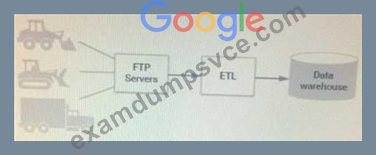
TerramEarth's existing architecture is composed of Linux-based systems that reside in a data center. These systems gzip CSV files from the field and upload via FTP, transform and aggregate them, and place the data in their data warehouse. Because this process takes time, aggregated reports are based on data that is 3 weeks old.
With this data, TerramEarth has been able to preemptively stock replacement parts and reduce unplanned downtime of their vehicles by 60%. However, because the data is stale, some customers are without their vehicles for up to 4 weeks while they wait for replacement parts.
Business Requirements
- Decrease unplanned vehicle downtime to less than 1 week, without
increasing the cost of carrying surplus inventory
- Support the dealer network with more data on how their customers use
their equipment IP better position new products and services.
- Have the ability to partner with different companies-especially with
seed and fertilizer suppliers in the fast-growing agricultural
business-to create compelling joint offerings for their customers
CEO Statement
We have been successful in capitalizing on the trend toward larger vehicles to increase the productivity of our customers. Technological change is occurring rapidly and TerramEarth has taken advantage of connected devices technology to provide our customers with better services, such as our intelligent farming equipment. With this technology, we have been able to increase farmers' yields by 25%, by using past trends to adjust how our vehicles operate. These advances have led to the rapid growth of our agricultural product line, which we expect will generate 50% of our revenues by 2020.
CTO Statement
Our competitive advantage has always been in the manufacturing process with our ability to build better vehicles for tower cost than our competitors. However, new products with different approaches are constantly being developed, and I'm concerned that we lack the skills to undergo the next wave of transformations in our industry. Unfortunately, our CEO doesn't take technology obsolescence seriously and he considers the many new companies in our industry to be niche players. My goals are to build our skills while addressing immediate market needs through incremental innovations.
For this question, refer to the TerramEarth case study. TerramEarth has equipped unconnected trucks with servers and sensors to collet telemetry dat
- A. Push the telemetry data in real-time to a streaming dataflow job that compresses the data, and store it in Cloud Bigtable.
- B. Push the telemetry data in Real-time to a streaming dataflow job that compresses the data, and store it in Google BigQuery.
- C. Next year they want to use the data to train machine learning models. They want to store this data in the cloud while reducing costs. What should they do?
- D. Have the vehicle' computer compress the data in hourly snapshots, and store it in a Google Cloud storage (GCS) Nearline bucket.
- E. Have the vehicle's computer compress the data in hourly snapshots, a Store it in a GCS Coldline bucket.
Answer: A
Explanation:
Storage is the best choice for data that you plan to access at most once a year, due to its slightly lower availability, 90-day minimum storage duration, costs for data access, and higher per- operation costs. For example:
Cold Data Storage - Infrequently accessed data, such as data stored for legal or regulatory reasons, can be stored at low cost as Coldline Storage, and be available when you need it.
Disaster recovery - In the event of a disaster recovery event, recovery time is key. Cloud Storage provides low latency access to data stored as Coldline Storage.
References: https://cloud.google.com/storage/docs/storage-classes
NEW QUESTION 75
You are developing an application using different microservices that should remain internal to the cluster. You want to be able to configure each microservice with a specific number of replicas. You also want to be able to address a specific microservice from any other microservice in a uniform way, regardless of the number of replicas the microservice scales to. You need to implement this solution on Google Kubernetes Engine. What should you do?
- A. Deploy each microservice as a Deployment. Expose the Deployment in the cluster using a Service, and use the Service DNS name to address it from other microservices within the cluster.
- B. Deploy each microservice as a Deployment. Expose the Deployment in the cluster using an Ingress, and use the Ingress IP address to address the Deployment from other microservices within the cluster.
- C. Deploy each microservice as a Pod. Expose the Pod in the cluster using a Service, and use the Service DNS name to address the microservice from other microservices within the cluster.
- D. Deploy each microservice as a Pod. Expose the Pod in the cluster using an Ingress, and use the Ingress IP address name to address the Pod from other microservices within the cluster.
Answer: A
NEW QUESTION 76
Dress4win has end to end tests covering 100% of their endpoints.
They want to ensure that the move of cloud does not introduce any new bugs.
Which additional testing methods should the developers employ to prevent an outage?
- A. They should enable google stack driver debugger on the application code to show errors in the code
- B. They should add canary tests so developers can measure how much of an impact the new release causes to latency
- C. They should add additional unit tests and production scale load tests on their cloud staging environment.
- D. They should run the end to end tests in the cloud staging environment to determine if the code is working as intended.
Answer: C
NEW QUESTION 77
A development manager is building a new application He asks you to review his requirements and identify what cloud technologies he can use to meet them. The application must
1 . Be based on open-source technology for cloud portability
2 . Dynamically scale compute capacity based on demand
3 . Support continuous software delivery
4 . Run multiple segregated copies of the same application stack
5 . Deploy application bundles using dynamic templates
6 . Route network traffic to specific services based on URL
Which combination of technologies will meet all of his requirements?
- A. Google Container Engine, Jenkins, and Helm
- B. Google Compute Engine and Cloud Deployment Manager
- C. Google Container Engine and Cloud Load Balancing
- D. Google Compute Engine, Jenkins, and Cloud Load Balancing
Answer: B
NEW QUESTION 78
Your web application must comply with the requirements of the European Union's General Data Protection Regulation (GDPR). You are responsible for the technical architecture of your web application. What should you do?
- A. Ensure that your web application only uses native features and services of Google Cloud Platform, because Google already has various certifications and provides "pass-on" compliance when you use native features.
- B. Ensure that Cloud Security Scanner is part of your test planning strategy in order to pick up any compliance gaps.
- C. Define a design for the security of data in your web application that meets GDPR requirements.
- D. Enable the relevant GDPR compliance setting within the GCPConsole for each of the services in use within your application.
Answer: C
Explanation:
Explanation
https://cloud.google.com/security/gdpr/?tab=tab4
Reference: https://www.mobiloud.com/blog/gdpr-compliant-mobile-app/
NEW QUESTION 79
Your solution is producing performance bugs in production that you did not see in staging and test environments. You want to adjust your test and deployment procedures to avoid this problem in the future. What should you do?
- A. Deploy smaller changes to production.
- B. Deploy fewer changes to production.
- C. Increase the load on your test and staging environments.
- D. Deploy changes to a small subset of users before rolling out to production.
Answer: D
NEW QUESTION 80
For this question, refer to the EHR Healthcare case study. You are responsible for designing the Google Cloud network architecture for Google Kubernetes Engine. You want to follow Google best practices. Considering the EHR Healthcare business and technical requirements, what should you do to reduce the attack surface?
- A. Use a private cluster with a public endpoint with master authorized networks configured.
- B. Use a private cluster with a private endpoint with master authorized networks configured.
- C. Use a public cluster with master authorized networks enabled and firewall rules.
- D. Use a public cluster with firewall rules and Virtual Private Cloud (VPC) routes.
Answer: B
Explanation:
https://cloud.google.com/kubernetes-engine/docs/concepts/private-cluster-concept#overview
NEW QUESTION 81
For this question, refer to the TerramEarth case study. To be compliant with European GDPR regulation, TerramEarth is required to delete data generated from its European customers after a period of 36 months when it contains personal data. In the new architecture, this data will be stored in both Cloud Storage and BigQuery. What should you do?
- A. Create a BigQuery table for the European data, and set the table retention period to 36 months. For Cloud Storage, use gsutil to create a SetStorageClass to NONE action when with an Age condition of 36 months.
- B. Create a BigQuery time-partitioned table for the European data, and set the partition expiration period to
36 months. For Cloud Storage, use gsutil to enable lifecycle management using a DELETE action with an Age condition of 36 months. - C. Create a BigQuery table for the European data, and set the table retention period to 36 months. For Cloud Storage, use gsutil to enable lifecycle management using a DELETE action with an Age condition of 36 months.
- D. Create a BigQuery time-partitioned table for the European data, and set the partition period to 36 months. For Cloud Storage, use gsutil to create a SetStorageClass to NONE action with an Age condition of 36 months.
Answer: A
NEW QUESTION 82
Google Cloud Platform resources are managed hierarchically using organization, folders, and projects.
When Cloud Identity and Access Management (IAM) policies exist at these different levels, what is the effective policy at a particular node of the hierarchy?
- A. The effective policy is the union of the policy set at the node and policies inherited from its ancestors
- B. The effective policy is the policy set at the node and restricted by the policies of its ancestors
- C. The effective policy is determined only by the policy set at the node
- D. The effective policy is the intersection of the policy set at the node and policies inherited from its ancestors
Answer: A
Explanation:
Explanation/Reference: https://cloud.google.com/resource-manager/docs/cloud-platform-resource-hierarchy
NEW QUESTION 83
......
Target Audience
The certification is aimed at those Cloud Architects who are able to design, manage, and develop robust, scalable, secure, dynamic, and highly available solutions to drive their organizational business objectives. These specialists can perform the following tasks:
- design, plan, and manage Cloud solution architectures;
- evaluate and optimize the business and technical processes;
- ensure the reliability of solutions and operations.
- design for compliance and security;
- manage the implementation of Cloud architecture;
Latest Professional-Cloud-Architect Pass Guaranteed Exam Dumps Certification Sample Questions: https://www.examdumpsvce.com/Professional-Cloud-Architect-valid-exam-dumps.html
Professional-Cloud-Architect Exam with Guarantee Updated 262 Questions: https://drive.google.com/open?id=1kzEE5NMmzEFS8N0op65Y4S2OB584amKg
