

MS-100 Free Certification Exam Material from ExamDumpsVCE with 304 Questions
Use Real MS-100 - 100% Cover Real Exam Questions
NEW QUESTION 55
You have a Microsoft 365 subscription.
You have the devices shown in the following table.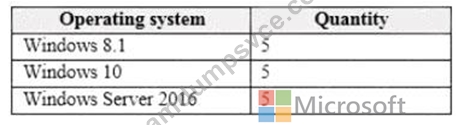
You need to onboard the devices to Windows Defender Advanced Threat Protection (ATP). The solution must avoid installing software on the devices whenever possible.
Which onboarding method should you use for each operating system? To answer, drag the appropriate methods to the correct operating systems. Each method may be used once, more than once, or not at all. You may need to drag the split bar between panes or scroll to view content.
NOTE: Each correct selection is worth one point.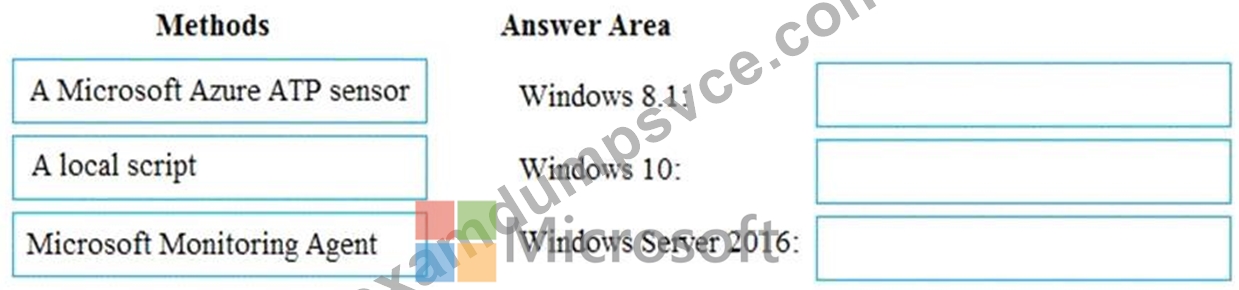
Answer:
Explanation: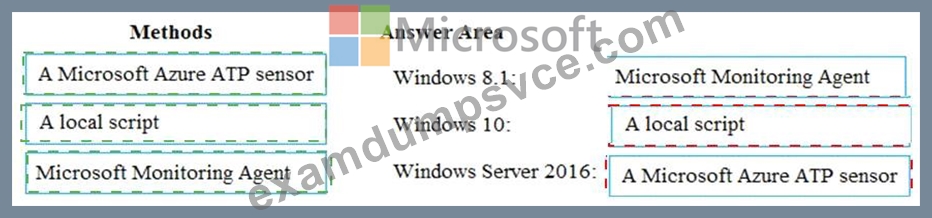
Explanation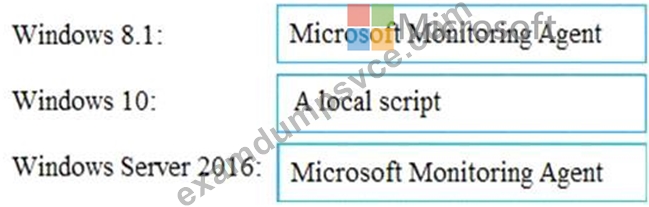
References:
https://docs.microsoft.com/en-us/windows/security/threat-protection/windows-defender-atp/onboard-downlevel-
https://docs.microsoft.com/en-us/windows/security/threat-protection/windows-defender-atp/configure-endpoints-
https://docs.microsoft.com/en-us/windows/security/threat-protection/windows-defender-atp/configure-server-end Box 1:
To onboard down-level Windows client endpoints to Microsoft Defender ATP, you'll need to:
Configure and update System Center Endpoint Protection clients.
Install and configure Microsoft Monitoring Agent (MMA) to report sensor data to Microsoft Defender ATP Box 2:
For Windows 10 clients, the following deployment tools and methods are supported:
Group Policy
System Center Configuration Manager
Mobile Device Management (including Microsoft Intune)
Local script
Box 3:
Windows Server 2016 can be onboarded by using Azure Security Centre. When you add servers in the Security Centre, the Microsoft Monitoring Agent is installed on the servers.
NEW QUESTION 56
You have a new Microsoft 365 subscription.
A user named User1 has a mailbox in Microsoft Exchange Online.
You need to log any changes to the mailbox folder permissions of User1.
Which command should you run? To answer, select the appropriate options in the answer area.
NOTE:Each correct selection is worth one point.
Answer:
Explanation:
Explanation
To enable auditing for a single mailbox (in this example, belonging to Holly Sharp), use this PowerShell command: Set-Mailbox username -AuditEnabled $true References:
https://support.microsoft.com/en-us/help/4026501/office-auditing-in-office-365-for-admins
https://docs.microsoft.com/en-us/powershell/module/exchange/mailboxes/set-mailbox?view=exchange-ps
NEW QUESTION 57
You have several Microsoft SharePoint document libraries in your on-premises environment.
You have a Microsoft 365 tenant that has directory synchronization implemented.
You plan to move all the document libraries to SharePoint Online.
You need to recommend a migration strategy for the document libraries.
Which three actions should you perform in sequence? To answer, move the appropriate actions from the list of actions to the answer area and arrange them in the correct order.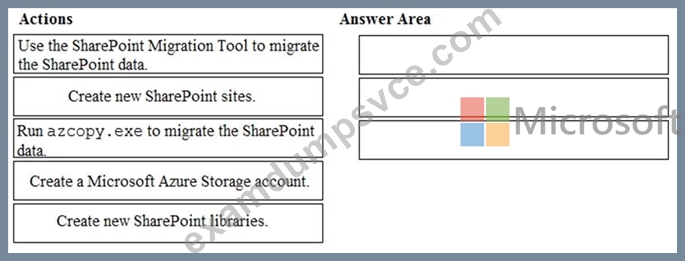
Answer:
Explanation: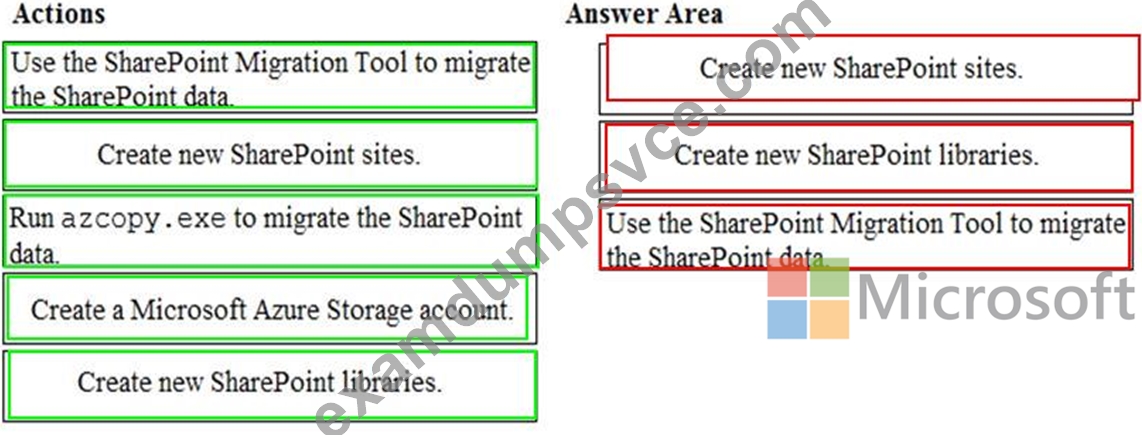
Reference:
https://docs.microsoft.com/en-us/sharepointmigration/how-to-use-the-sharepoint-migration-tool
NEW QUESTION 58
Your company has a Microsoft 365 subscription.
You need to identify which users performed the following privileged administration tasks:
Deleted a folder from the second-stage Recycle Bin if Microsoft SharePoint Opened a mailbox of which the user was not the owner Reset a user password What should you use?
- A. Security & Compliance content search
- B. Security & Compliance audit log search
- C. Microsoft Azure Active Directory (Azure AD) sign-ins
- D. Microsoft Azure Active Directory (Azure AD) audit logs
Answer: D
Explanation:
References:
https://docs.microsoft.com/en-us/azure/azure-monitor/platform/activity-logs-overview
NEW QUESTION 59
You are evaluating the use of multi-factor authentication (MFA).
For each of the following statements, select Yes if the statement is true. Otherwise, select No.
NOTE: Each correct selection is worth one point.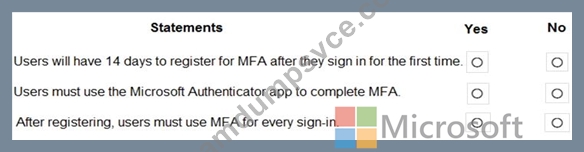
Answer:
Explanation: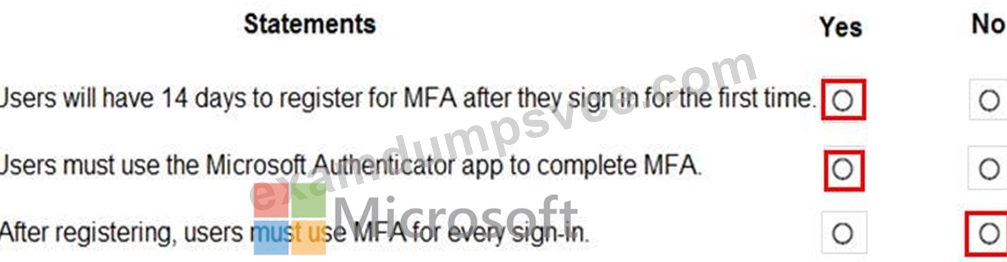
Reference:
https://docs.microsoft.com/en-us/azure/active-directory/identity-protection/howto-identity-protection-configure-mfa-policy
https://blog.admindroid.com/configuring-and-managing-mfa-in-office-365/
NEW QUESTION 60
Your company has a Microsoft 365 subscription that contains the users shown in the following table.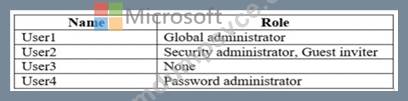
You need to identify which users can perform the following administrative tasks:
Modify the password protection policy.
Create guest user accounts.
Which users should you identify for each task? To answer, select the appropriate options in the answer area.
NOTE: Each correct selection is worth one point.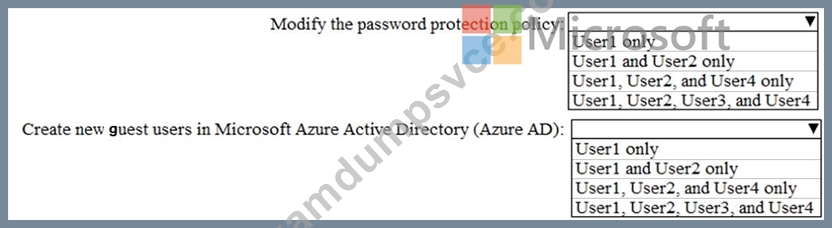
Answer:
Explanation: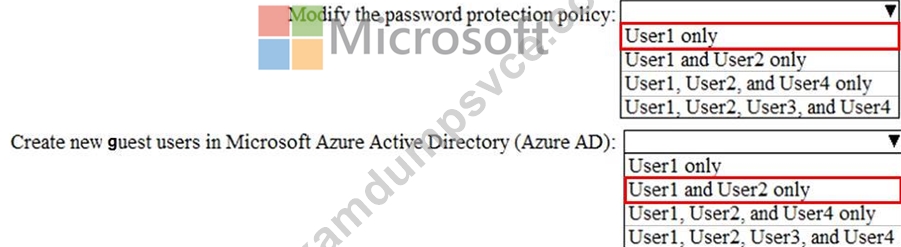
Explanation:
Only a Global Admin can modify the password protection policy.
A Global Admin or a user with the Guest Inviter role can create guest accounts.
Reference:
https://docs.microsoft.com/en-us/azure/active-directory/authentication/howto-password-ban-bad-on-premises-operations
NEW QUESTION 61
Please wait while the virtual machine loads. Once loaded, you may proceed to the lab section. This may take a few minutes, and the wait time will not be deducted from your overall test time.
When the Next button is available, click it to access the lab section. In this section, you will perform a set of tasks in a live environment. While most functionality will be available to you as it would be in a live environment, some functionality (e.g., copy and paste, ability to navigate to external websites) will not be possible by design.
Scoring is based on the outcome of performing the tasks stated in the lab. In other words, it doesn't matter how you accomplish the task, if you successfully perform it, you will earn credit for that task.
Labs are not timed separately, and this exam may have more than one lab that you must complete. You can use as much time as you would like to complete each lab. But, you should manage your time appropriately to ensure that you are able to complete the lab(s) and all other sections of the exam in the time provided.
Please note that once you submit your work by clicking the Next button within a lab, you will NOT be able to return to the lab.
You may now click next to proceed to the lab.
Lab information
Use the following login credentials as needed:
To enter your username, place your cursor in the Sign in box and click on the username below.
To enter your password, place your cursor in the Enter password box and click on the password below.
Microsoft 365 Username:[email protected]
Microsoft 365 Password:m3t^We$Z7&xy
If the Microsoft 365 portal does not load successfully in the browser, press CTRL-K to reload the portal in a new browser tab.
The following information is for technical support purposes only:
Lab Instance:11440873
You need to ensure that all the users in your organization are prompted to change their password every 60 days. The solution must ensure that the users are reminded that their password must be changed 10 days before the required change.
To answer, sign in to the Microsoft 365 portal.
Answer:
Explanation:
See explanation below.
Explanation
You need to configure the Password Expiration Policy.
1. Sign in to the Microsoft 365 Admin Center.
2. In the left navigation pane, expand the Settings section then select the Settings option.
3. Click on Security and Privacy.
4. Select the Password Expiration Policy.
5. Ensure that the checkbox labelled "Set user passwords to expire after a number of days" is ticked.
6. Enter 60 in the "Days before passwords expire" field.
7. Enter 10 in the "Days before a user is notified about expiration" field.
8. Click the 'Save changes' button.
Topic 1, Contoso, Ltd
This is a case study.Case studies are not timed separately. You can use as much exam time as you would like to complete each case. However, there may be additional case studies and sections on this exam. You must manage your time to ensure that you are able to complete all questions included on this exam in the time provided.
To answer the questions included in a case study, you will need to reference information that is provided in the case study. Case studies might contain exhibits and other resources that provide more information about the scenario that is described in the case study. Each question is independent of the other questions in this case study.
At the end of this case study, a review screen will appear. This screen allows you to review your answer and to make changes before you move to the next section of the exam. After you begin a new section, you cannot return to this section.
To start the case study
To display the first question in this case study, click the button. Use the buttons in the left pane to explore the content of the case study before you answer the questions. Clicking these buttons displays information such as business requirements, existing environment, and problem statements. When you are ready to answer a question, click theQuestionbutton to return to the question.
Overview
Contoso, Ltd. is a consulting company that has a main office in Montreal and two branch offices in Seattle and New York.
The offices have the users and devices shown in the following table.
Contoso recently purchased a Microsoft 365 E5 subscription.
Existing Environment
The network contains an Active directory forest named contoso.com and a Microsoft Azure Active Directory (Azure AD) tenant named contoso.onmicrosoft.com.
You recently configured the forest to sync to the Azure AD tenant.
You add and then verify adatum.com as an additional domain name.
All servers run Windows Server 2016.
All desktop computers and laptops run Windows 10 Enterprise and are joined to contoso.com.
All the mobile devices in the Montreal and Seattle offices run Android. All the mobile devices in the New York office run iOS.
Contoso has the users shown in the following table.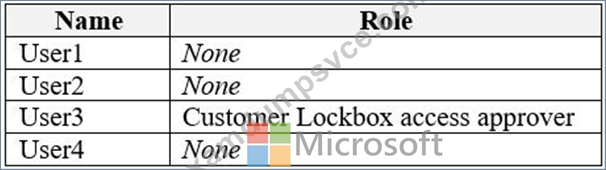
Contoso has the groups shown in the following table.
Microsoft Office 365 licenses are assigned only to Group2.
The network also contains external users from a vendor company who have Microsoft accounts that use a suffix of @outlook.com.
Requirements
Planned Changes
Contoso plans to provide email addresses for all the users in the following domains:
* East.adatum.com
* Contoso.adatum.com
* Humongousinsurance.com
Technical Requirements
Contoso identifies the following technical requirements:
* All new users must be assigned Office 365 licenses automatically.
* The principle of least privilege must be used whenever possible.
Security Requirements
Contoso identifies the following security requirements:
* Vendors must be able to authenticate by using their Microsoft account when accessing Contoso resources.
* User2 must be able to view reports and schedule the email delivery of security and compliance reports.
* The members of Group1 must be required to answer a security question before changing their password.
* User3 must be able to manage Office 365 connectors.
* User4 must be able to reset User3 password.
NEW QUESTION 62
Your network contains an on-premises Active Directory domain named contoso.com that syncs to Azure Active Directory (Azure AD).
You have users in contoso.com as shown in the following table.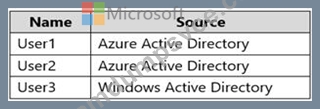
The users have the passwords shown in the following table.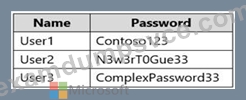
You implement password protection as shown in the following exhibit.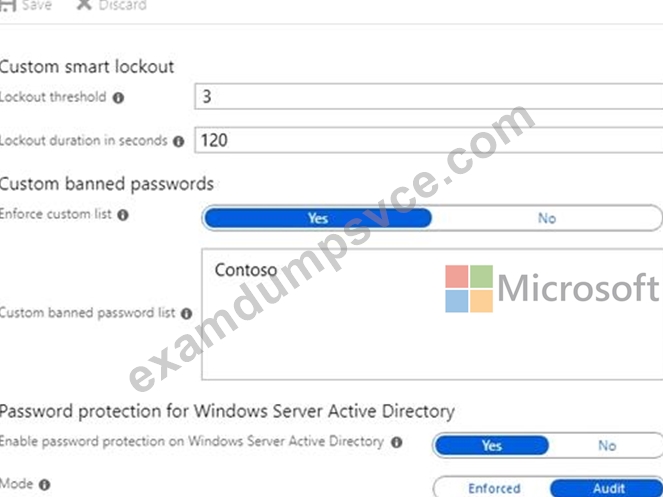
For each of the following statements, select Yes if the statement is true. Otherwise, select No.
NOTE: Each correct selection is worth one point.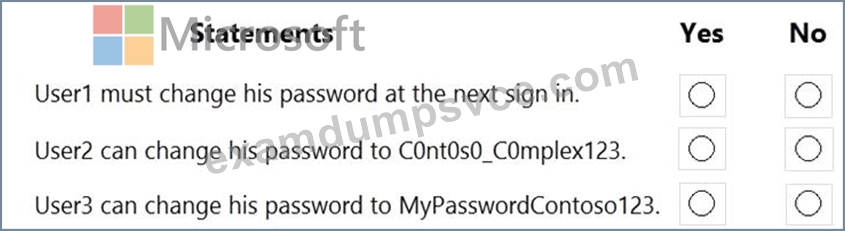
Answer:
Explanation: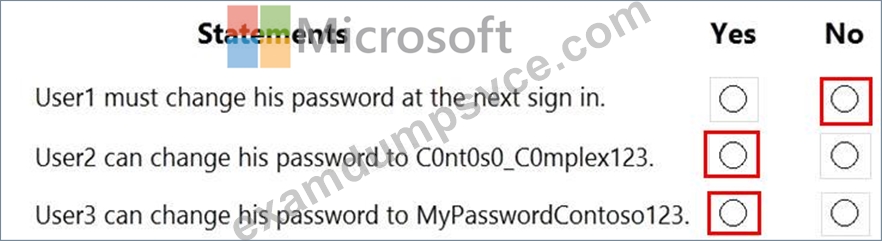
Reference:
https://docs.microsoft.com/en-us/azure/active-directory/authentication/concept-password-ban-bad
NEW QUESTION 63
Your network contains an on-premises Active Directory domain. The domain contains a server named Server1. Server1 has a share named Share1 that contains the files shown in the following table.
You have a hybrid deployment of Microsoft 365.
You create a Microsoft SharePoint site collection named Col lection1.
You plan to migrate Share1 to a document library in Collection1
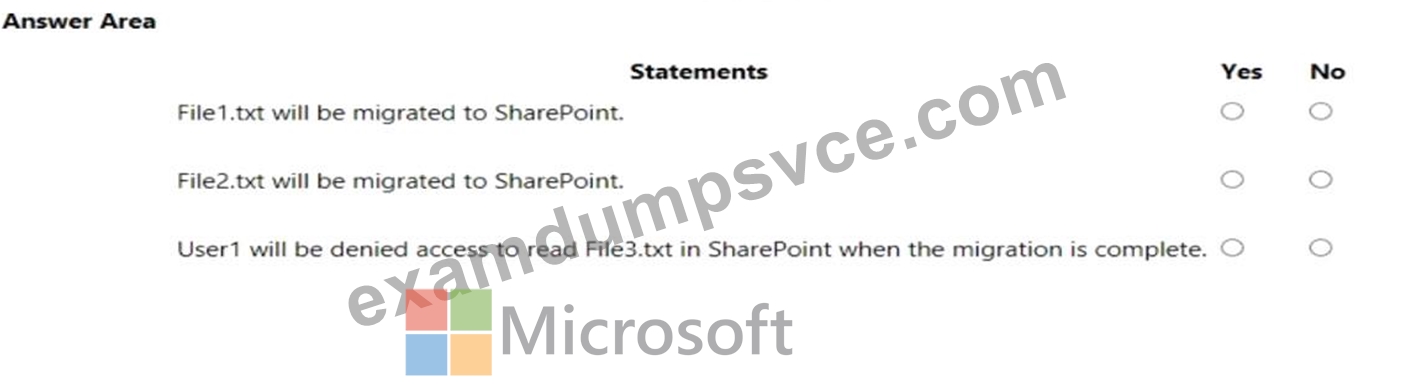
You configure the SharePoint Migration Tool as shown in the exhibit. (Click the Exhibit tab.) For each of the following statements, select Yes if the statement is true. Otherwise, select No.
NOTE: Each correct selection is worth one point.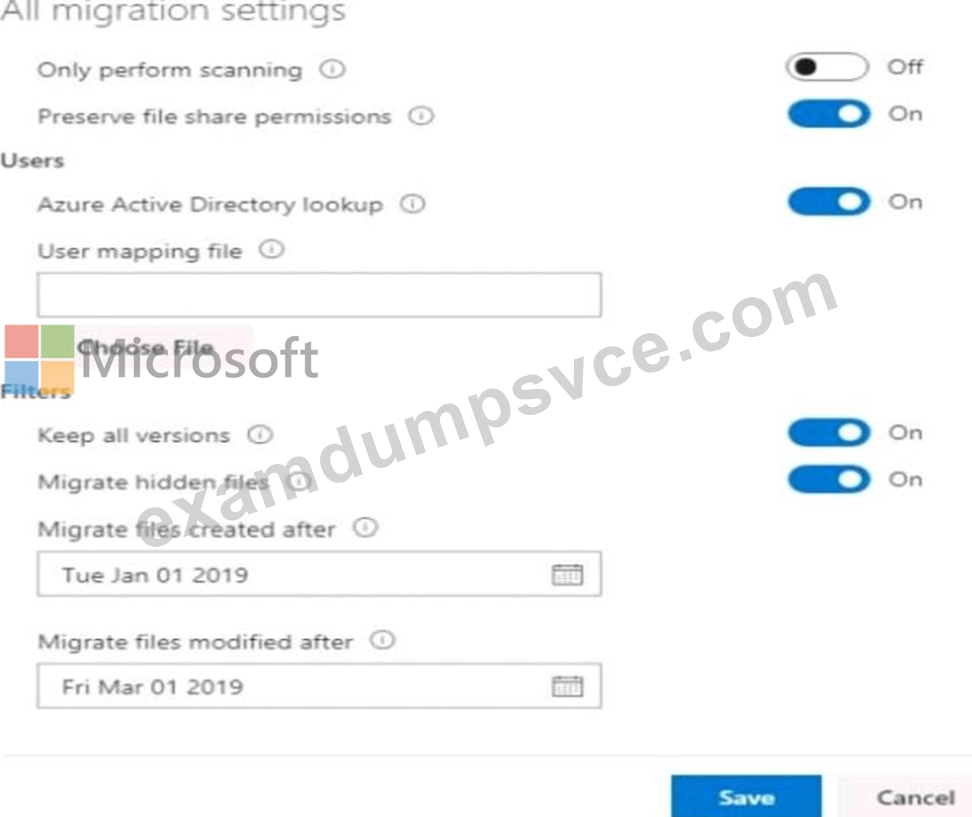
Answer:
Explanation: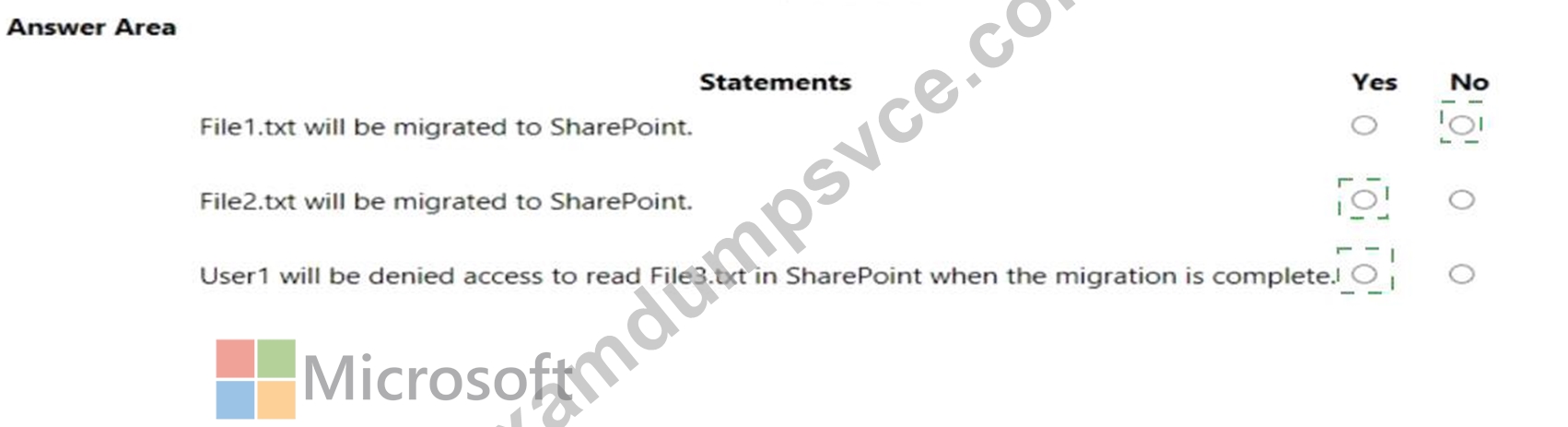
Explanation
.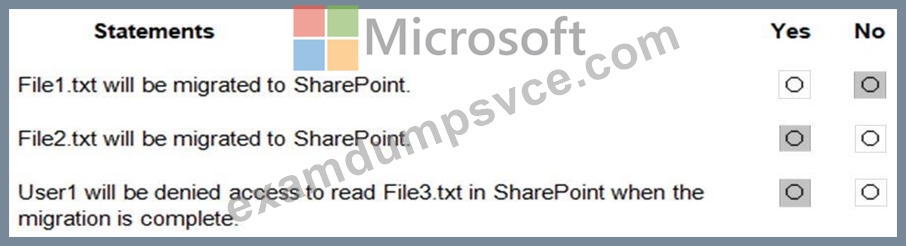
Box 1: No
File1.txt will not be migrated as it was created before Jan 1 2019
Box 2: Yes
File2.txt will be migrated as it was created after Jan 1 2019 and was modified after Mar 1 2019.
Box 3: Yes
File permissions will be maintained after the migration.
References:
https://docs.microsoft.com/en-us/sharepointmigration/spmt-settings
NEW QUESTION 64
You need to assign User2 the required roles to meet the security requirements and the technical requirements.
To which two roles should you assign User2? Each correct answer presents part of the solution.
NOTE: Each correct selection is worth one point.
- A. the Exchange Online Help Desk role
- B. the Exchange Online Compliance Management role
- C. the Microsoft 365 Records Management role
- D. the Exchange View-only Organization Management role
- E. the Microsoft 365 Security Reader role
Answer: B,E
Explanation:
* User2 must be able to view reports and schedule the email delivery of security and compliance reports.
The Security Reader role can view reports but not schedule the email delivery of security and compliance reports.
The Exchange Online Compliance Management role can schedule the email delivery of security and compliance reports.
Reference:
https://docs.microsoft.com/en-us/exchange/permissions-exo/permissions-exo Manage User Identity and Roles Testlet 3 This is a case study. Case studies are not timed separately. You can use as much exam time as you would like to complete each case. However, there may be additional case studies and sections on this exam.
You must manage your time to ensure that you are able to complete all questions included on this exam in the time provided.
To answer the questions included in a case study, you will need to reference information that is provided in the case study. Case studies might contain exhibits and other resources that provide more information about the scenario that is described in the case study. Each question is independent of the other questions in this case study.
At the end of this case study, a review screen will appear. This screen allows you to review your answer and to make changes before you move to the next section of the exam. After you begin a new section, you cannot return to this section.
To start the case study
To display the first question in this case study, click the Next button. Use the buttons in the left pane to explore the content of the case study before you answer the questions. Clicking these buttons displays information such as business requirements, existing environment, and problem statements. When you are ready to answer a question, click the Question button to return to the question.
Overview
Fabrikam, Inc. is an electronics company that produces consumer products. Fabrikam has 10,000 employees worldwide.
Fabrikam has a main office in London and branch offices in major cities in Europe, Asia, and the United States.
Existing Environment
Active Directory Environment
The network contains an Active Directory forest named fabrikam.com. The forest contains all the identities used for user and computer authentication.
Each department is represented by a top-level organizational unit (OU) that contains several child OUs for user accounts and computer accounts.
All users authenticate to on-premises applications by signing in to their device by using a UPN format of [email protected].
Fabrikam does NOT plan to implement identity federation.
Network Infrastructure
Each office has a high-speed connection to the Internet.
Each office contains two domain controllers. All domain controllers are configured as a DNS server.
The public zone for fabrikam.com is managed by an external DNS server.
All users connect to an on-premises Microsoft Exchange Server 2016 organization. The users access their email by using Outlook Anywhere, Outlook on the web, or the Microsoft Outlook app for iOS. All the Exchange servers have the latest cumulative updates installed.
All shared company documents are stored on a Microsoft SharePoint Server farm.
Requirements
Planned Changes
Fabrikam plans to implement a Microsoft 365 Enterprise subscription and move all email and shared documents to the subscription.
Fabrikam plans to implement two pilot projects:
* Project1: During Project1, the mailboxes of 100 users in the sales department will be moved to Microsoft
365.
* Project2: After the successful completion of Project1, Microsoft Teams & Skype for Business will be enabled in Microsoft 365 for the sales department users.
Fabrikam plans to create a group named UserLicenses that will manage the allocation of all Microsoft 365 bulk licenses.
Technical Requirements
Fabrikam identifies the following technical requirements:
* All users must be able to exchange email messages successfully during Project1 by using their current email address.
* Users must be able to authenticate to cloud services if Active Directory becomes unavailable.
* A user named User1 must be able to view all DLP reports from the Microsoft 365 admin center.
* Microsoft Office 365 ProPlus applications must be installed from a network share only.
* Disruptions to email access must be minimized.
Application Requirements
Fabrikam identifies the following application requirements:
* An on-premises web application named App1 must allow users to complete their expense reports online.
* The installation of feature updates for Office 365 ProPlus must be minimized.
Security Requirements
Fabrikam identifies the following security requirements:
* After the planned migration to Microsoft 365, all users must continue to authenticate to their mailbox and to SharePoint sites by using their UPN.
* The memberships of UserLicenses must be validated monthly. Unused user accounts must be removed from the group automatically.
* After the planned migration to Microsoft 365, all users must be signed in to on-premises and cloud-based applications automatically.
* The principle of least privilege must be used.
NEW QUESTION 65
You have a Microsoft 365 tenant.
You have a line-of-business application named App1 that users access by using the My Apps portal.
After some recent security breaches, you implement a conditional access policy for App1 that uses Conditional Access App Control.
You need to be alerted by email if impossible travel is detected for a user of App1. The solution must ensure that alerts are generated for App1 only.
What should you do?
- A. From the Azure Active Directory admin center, modify the conditional access policy.
- B. From Microsoft Cloud App Security, create a Cloud Discovery anomaly detection policy.
- C. From Microsoft Cloud App Security, create an app discovery policy.
- D. From Microsoft Cloud App Security, modify the impossible travel alert policy.
Answer: B
Explanation:
References:
https://docs.microsoft.com/en-us/cloud-app-security/cloud-discovery-anomaly-detection-policy
NEW QUESTION 66
Note: This question is part of a series of questions that present the same scenario. Each question in the series contains a unique solution that might meet the stated goals. Some question sets might have more than one correct solution, while others might not have a correct solution.
After you answer a question in this section, you will NOT be able to return to it. As a result, these questions will not appear in the review screen.
You need to assign User2 the required roles to meet the security requirements.
Solution: From the Office 365 admin center, you assign User2 the Security Reader role. From the Exchange admin center, you assign User2 the Compliance Management role.
Does this meet the goal?
- A. Yes
- B. NO
Answer: B
NEW QUESTION 67
You create a Microsoft 365 subscription.
You plan to deploy Microsoft Office 365 ProPlus applications to all the client computers at your company.
You prepare the following XML file for the planned deployment.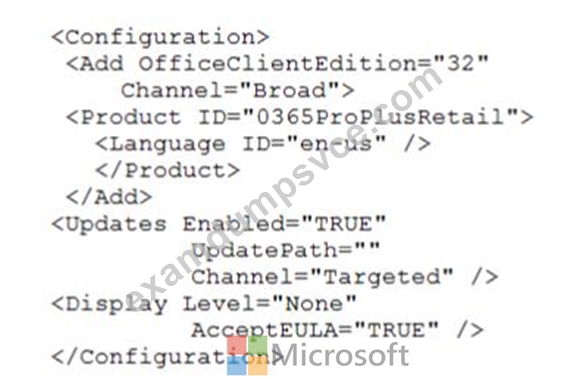
Use the drop-down menus to select the answer choice that completes each statement based on the information presented in the graphic.
NOTE: Each correct selection is worth one point.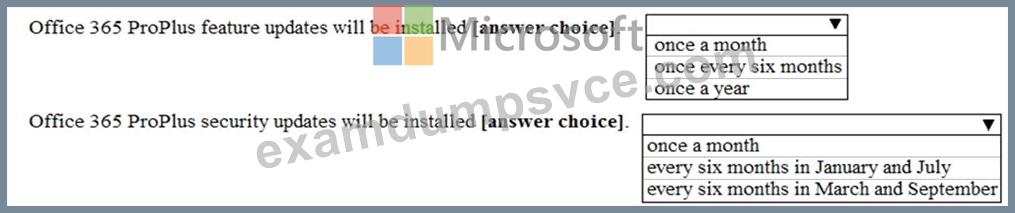
Answer:
Explanation: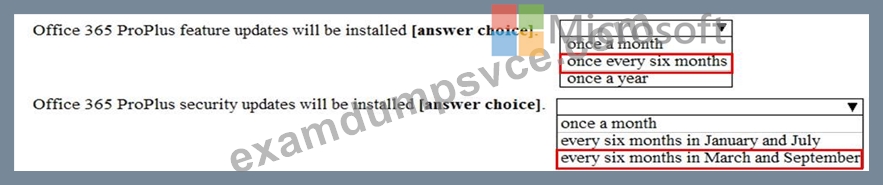
References:
https://docs.microsoft.com/en-us/deployoffice/configuration-options-for-the-office-2016-deployment-tool#updates-element
https://docs.microsoft.com/en-us/deployoffice/overview-of-update-channels-for-office-365-proplus
NEW QUESTION 68
Note: This question is part of a series of questions that present the same scenario. Each question in the series contains a unique solution that might meet the stated goals. Some question sets might have more than one correct solution, while others might not have a correct solution.
After you answer a question in this section, you will NOT be able to return to it. As a result, these questions will not appear in the review screen.
You need to assign User2 the required roles to meet the security requirements.
Solution: From the Office 365 admin center, you assign User2 the Security Reader role.
From the Exchange admin center, you assign User2 the Help Desk role.
Does this meet the goal?
- A. Yes
- B. NO
Answer: B
Explanation:
Explanation
* User2 must be able to view reports and schedule the email delivery of security and compliance reports.
The Security Reader role can view reports but not schedule the email delivery of security and compliance reports.
The Help Desk role cannot schedule the email delivery of security and compliance reports.
Reference:
https://docs.microsoft.com/en-us/exchange/permissions-exo/permissions-exo
NEW QUESTION 69
Note: This question is part of a series of questions that present the same scenario. Each question in the series contains a unique solution that might meet the stated goals. Some question sets might have more than one correct solution, while others might not have a correct solution.
After you answer a question in this section, you will NOT be able to return to it. As a result, these questions will not appear in the review screen.
Your network contains an on-premises Active Directory domain named contoso.com. The domain contains the users shown in the following table.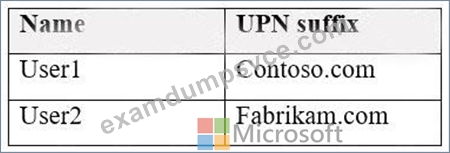
The domain syncs to an Azure Active Directory (Azure AD) tenant named contoso.com as shown in the exhibit. (Click the Exhibit tab.)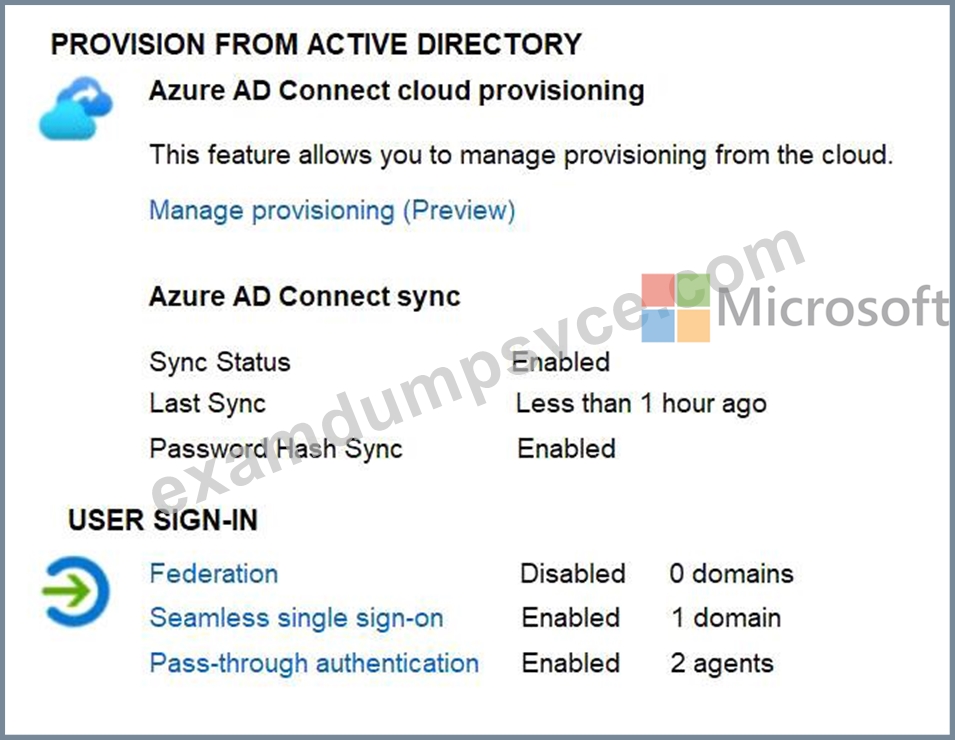
User2 fails to authenticate to Azure AD when signing in as [email protected].
You need to ensure that User2 can access the resources in Azure AD.
Solution: From the on-premises Active Directory domain, you assign User2 the Allow logon locally user right.
You instruct User2 to sign in as [email protected].
Does this meet the goal?
- A. No
- B. Yes
Answer: A
Explanation:
Explanation
This is not a permissions issue.
The on-premises Active Directory domain is named contoso.com. To enable users to sign on using a different UPN (different domain), you need to add the domain to Microsoft 365 as a custom domain.
NEW QUESTION 70
You company has a Microsoft Azure Active Directory (Azure AD) tenant that contains the users shown in the following table.
The tenant includes a security group named Admin1. Admin1 will be used to manage administrative accounts.
You need to identify which users can perform the following administrative tasks:
Create guest user accounts.
Add User3 to Admin1.
Which users should you identify for each task? To answer, select the appropriate options in the answer area.
NOTE: Each correct selection is worth one point.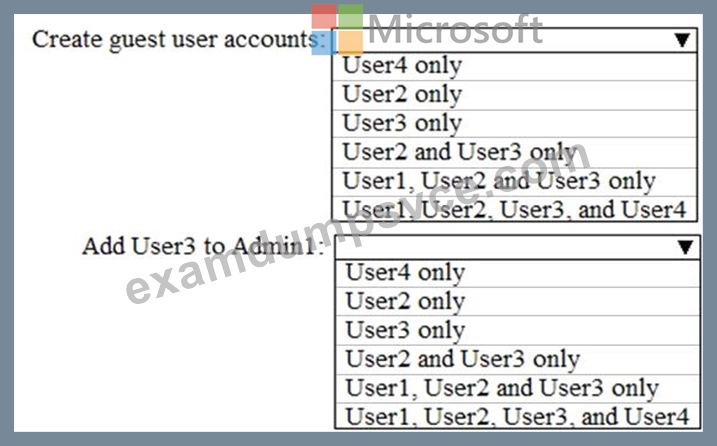
Answer:
Explanation: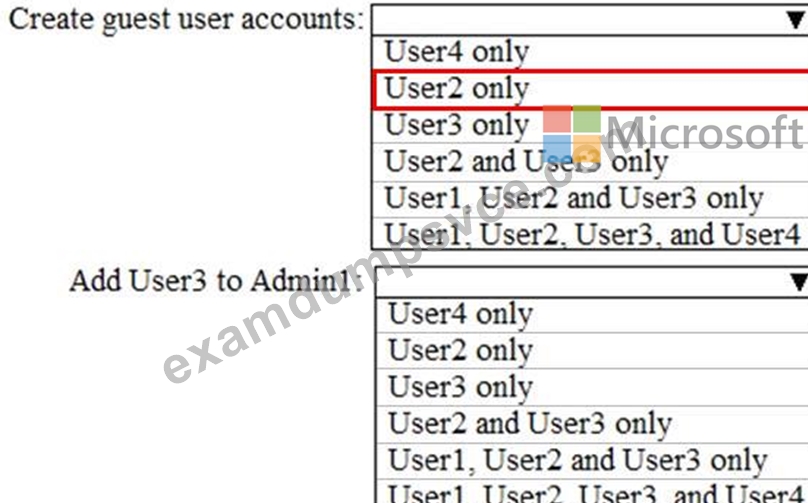
Explanation:
References:
https://docs.microsoft.com/en-us/azure/active-directory/users-groups-roles/directory-assign-admin-roles
NEW QUESTION 71
Your network contains an Active Directory domain and a Microsoft Azure Active Directory (Azure AD) tenant.
The network uses a firewall that contains a list of allowed outbound domains.
You began to implement directory synchronization.
You discover that the firewall configuration contains only the following domain names in the list of allowed domains:
* *.microsof.com
* *.office.com
Directory synchronization fails.
You need to ensure that directory synchronization completes successfully.
What is the best approach to achieve the goal? More than one answer choice may achieve the goal. Select the BEST answer.
- A. Deploy an Azure AD Connect sync server in staging mode.
- B. From Azure AD Connect, modify the Customize synchronization options task
- C. From the firewall, modify the list of allowed outbound domains.
- D. From the firewall, allow the IP address range of the Azure data center for outbound communication.
- E. From the firewall, create a list of allowed inbound domains.
Answer: C
NEW QUESTION 72
Your company has an on-premises Microsoft Exchange Server 2016 organization and a Microsoft 365 Enterprise subscription.
You plan to migrate mailboxes and groups to Exchange Online.
You start a new migration batch.
Users report slow performance when they use the on-premises Exchange Server organization.
You discover that the migration is causing the slow performance.
You need to reduce the impact of the mailbox migration on the end-users.
What should you do?
- A. Configure back pressure.
- B. Create a mail flow rule.
- C. Modify the migration endpoint settings.
- D. Create a throttling policy.
Answer: C
Explanation:
Section: [none]
Explanation:
The migration is causing the slow performance. This suggests that the on-premise Exchange server is struggling under the load of copying the mailboxes to Exchange Online. You can reduce the load on the on- premise server by reducing the maximum number of concurrent mailbox migrations. Migrating just a few mailboxes at a time will have less of a performance impact than migrating many mailboxes concurrently.
Reference:
https://support.microsoft.com/en-gb/help/2797784/how-to-manage-the-maximum-concurrent-migration- batches-in-exchange-onl
NEW QUESTION 73
Your company has a Microsoft Azure Active Directory (Azure AD) tenant named contoso.onmicrosoft.com.
You purchase a domain named contoso.com from a registrar and add all the required DNS records.
You create a user account named User1. User1 is configured to sign in as [email protected].
You need to configure User1 to sign in as [email protected].
Which three actions should you perform in sequence? To answer, move the appropriate actions from the list of actions to the answer area and arrange them in the correct order.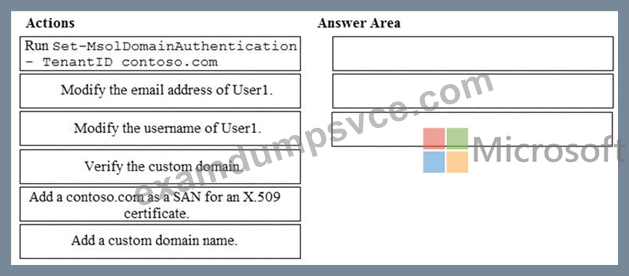
Answer:
Explanation: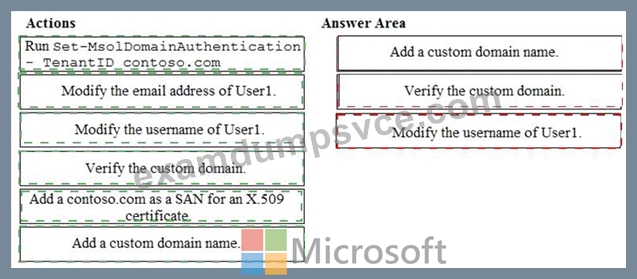
Explanation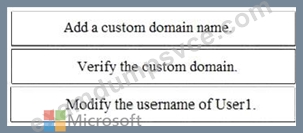
NEW QUESTION 74
You have retention policies in Microsoft 365 as shown in the following table.
Policy1 is configured as shown in the Policy1 exhibit. (Click the
Policy1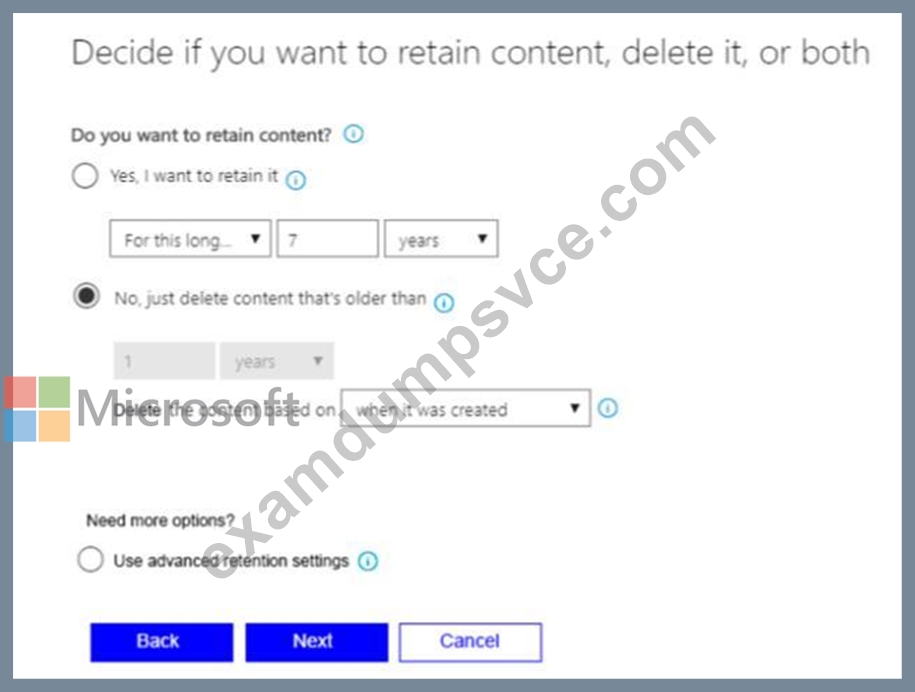
Policy1 is configured as shown in the Policy2 exhibit. (Click the Policy2 tab.) Policy2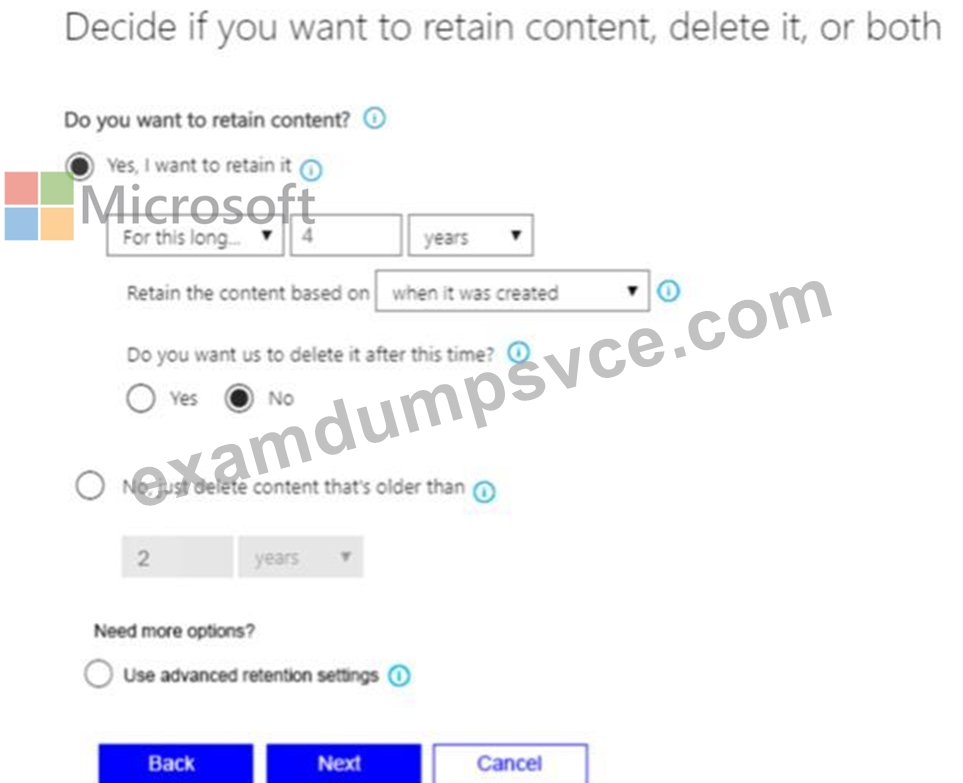
For each of the following statements, select Yes if the statement is true. Otherwise, select No.
NOTE: Each correct selection is worth one point.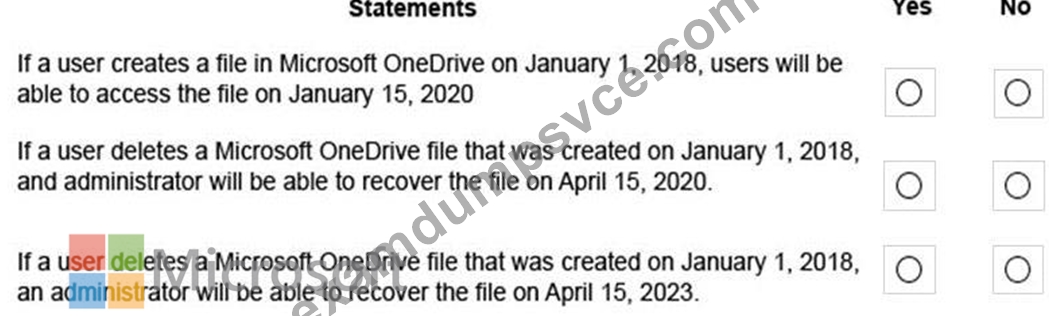
Answer:
Explanation:
Explanation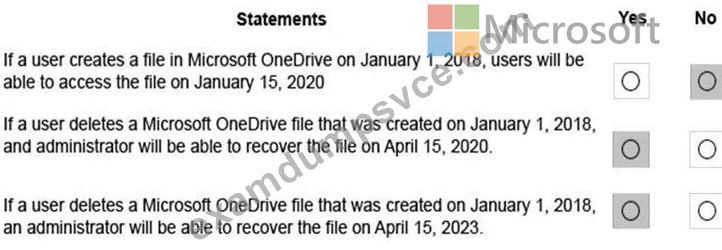
* Retention wins over deletion. Suppose that one retention policy says to delete Exchange email after three years, but another retention policy says to retain Exchange email for five years and then delete it.
Any content that reaches three years old will be deleted and hidden from the users' view, but still retained in the Recoverable Items folder until the content reaches five years old, when it is permanently deleted.
* The longest retention period wins. If content is subject to multiple policies that retain content, it will be retained until the end of the longest retention period.
Box 1: No.
The file will be deleted and hidden from the users' view, but still retained in the Recoverable Items folder. An administrator would need to recover the file.
Box 2: Yes.
The file will be deleted and hidden from the users' view, but still retained in the Recoverable Items folder. An administrator will be able to recover the file.
Box 3: Yes.
2018 to 2023 is five years. Policy2 has a retention period of four years. However, Policy2 is configured to not delete the files after the four-year retention period.
Reference:
https://docs.microsoft.com/en-us/office365/securitycompliance/retention-policies#the-principles-of-retention-or-
NEW QUESTION 75
You need to meet the security requirement for the vendors.
What should you do?
- A. From the Azure portal, modify the authentication methods.
- B. From the Azure portal, add an identity provider.
- C. From Azure Cloud Shell, run the New-AzureADMSInvitation and specify the -InvitedIserEmailAddress cmdlet.
- D. From Azure Cloud Shell, run the Set-MsolUserPrincipalName and specify the -tenantID parameter.
Answer: C
Explanation:
Explanation
* Vendors must be able to authenticate by using their Microsoft account when accessing Contoso
* resources.
You can invite guest users to the directory, to a group, or to an application. After you invite a user through any of these methods, the invited user's account is added to Azure Active Directory (Azure AD), with a user type of Guest. The guest user must then redeem their invitation to access resources. An invitation of a user does not expire.
The invitation will include a link to create a Microsoft account. The user can then authenticate using their Microsoft account. In this question, the vendors already have Microsoft accounts so they can authenticate using them.
In this solution, we are creating guest account invitations by using the New-AzureADMSInvitation cmdlet and specifying the -InvitedUserEmailAddress parameter.
Reference:
https://docs.microsoft.com/en-us/azure/active-directory/b2b/add-users-administrator
https://docs.microsoft.com/en-us/powershell/module/azuread/new-azureadmsinvitation?view=azureadps-2.0
NEW QUESTION 76
Your network contains an Active Directory forest named contoso.local.
You have a Microsoft 365 subscription.
You plan to implement a directory synchronization solution that will use password hash synchronization.
From the Microsoft 365 admin center, you verify the contoso.com domain name.
You need to prepare the environment for the planned directory synchronization solution.
What should you do first?
- A. From Active Directory Users and Computers, modify the UPN suffix for all users.
- B. From Active Directory Domains and Trusts, add contoso.com as a UPN suffix.
- C. From the public DNS zone of contoso.com, add a new mail exchanger (MX) record.
- D. From the Microsoft 365 admin center, verify the contoso.local domain name.
Answer: B
Explanation:
Explanation/Reference:
Explanation:
The on-premise Active Directory domain is named contoso.local. Therefore, all the domain users accounts will have a UPN suffix of contoso.local by default.
To enable directory synchronization that will use password hash synchronization, you need to configure the domain user accounts to have the same UPN suffix as the verified domain (contoso.com in this case). Before you can change the UPN suffix of the domain user accounts to contoso.com, you need to add contoso.com as a UPN suffix in the domain.
Reference:
https://docs.microsoft.com/en-us/azure/active-directory/hybrid/plan-connect-userprincipalname
NEW QUESTION 77
You have a Microsoft Azure Active Directory (Azure AD) tenant named contoso.com that includes a user named User1.
You enable multi-factor authentication for contoso.com and configure the following two fraud alert settings:
* Set Allow users to submit fraud alerts: On
* Automatically block users who report fraud: On
You need to instruct the users in your organization to use the fraud reporting features correctly.
What should you tell the users to do? To answer, select the appropriate options in the answer area.
NOTE: Each correct selection is worth one point.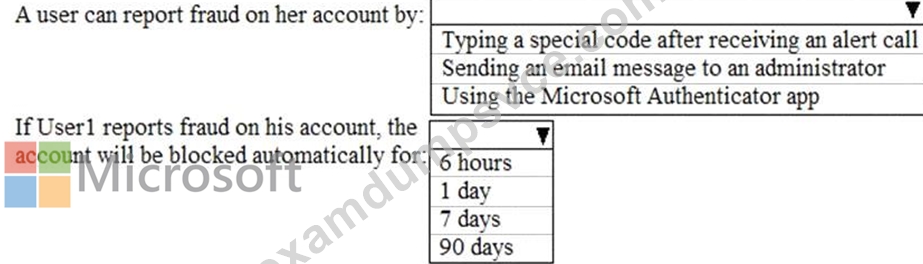
Answer:
Explanation: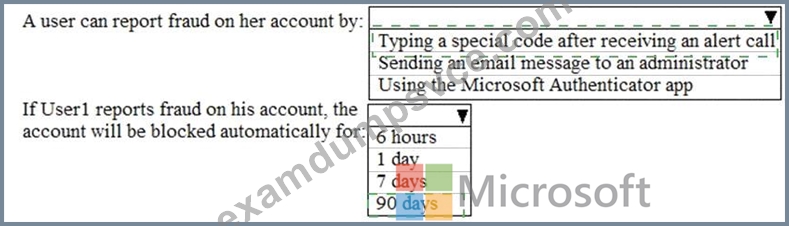
Explanation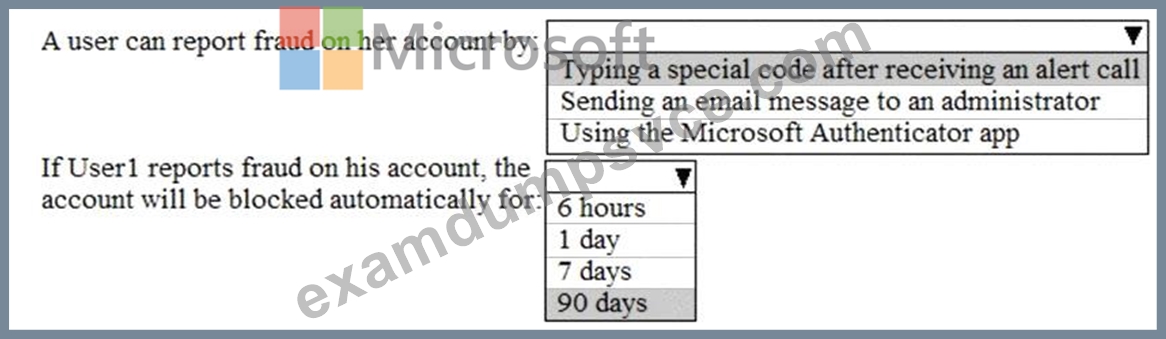
References:
https://docs.microsoft.com/en-us/azure/active-directory/authentication/howto-mfa-mfasettings#fraud-alert
NEW QUESTION 78
You create the Microsoft 365 tenant.
You implement Azure AD Connect as shown in the following exhibit.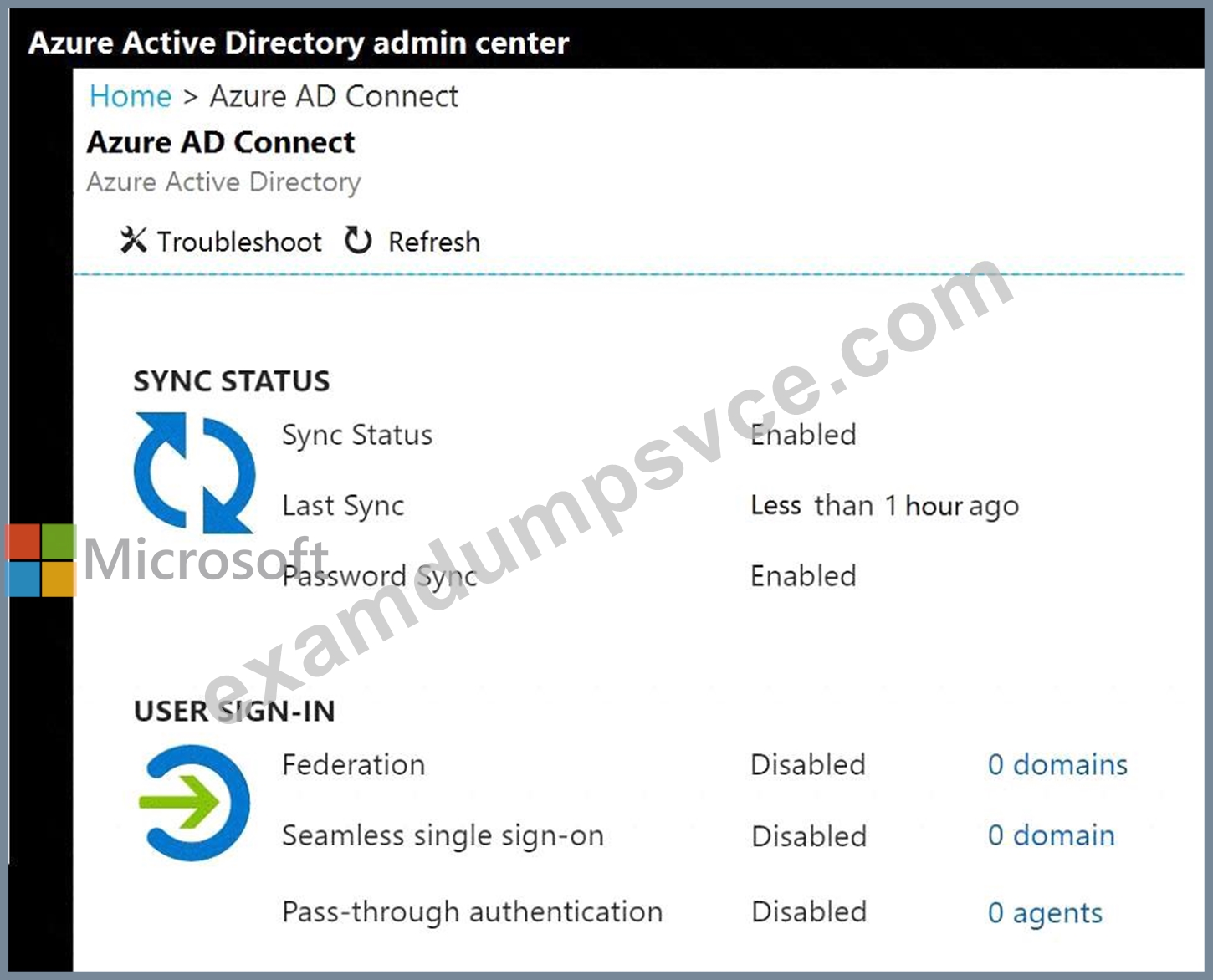
Use the drop-down menus to select the answer choice that completes each statement based on the information presented in the graphic.
NOTE: Each correct selection is worth one point.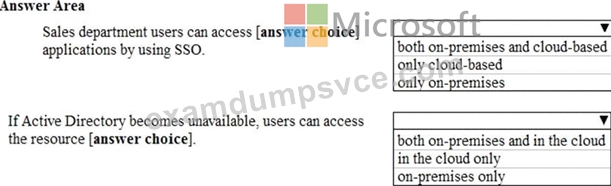
Answer:
Explanation: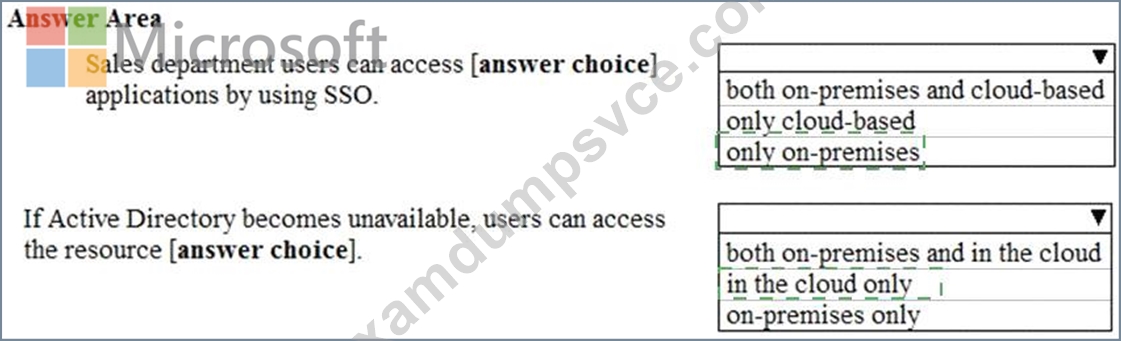
Explanation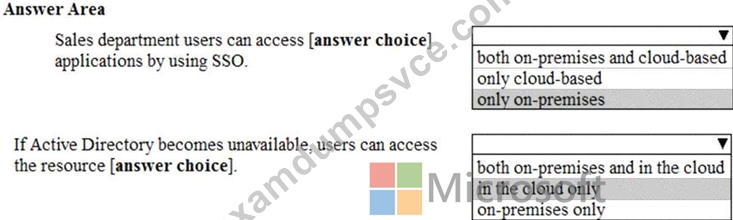
NEW QUESTION 79
......
Dumps Brief Outline Of The MS-100 Exam: https://www.examdumpsvce.com/MS-100-valid-exam-dumps.html
MS-100 Training & Certification Get Latest Microsoft 365 : https://drive.google.com/open?id=1nHY6bNonXdYvGpHu4KZ0TruQz-ZiY6jK
