

[Jan-2022] Latest Oracle 1Z0-060 exam dumps and online Test Engine
Oracle 1Z0-060: Selling Oracle Database Products and Solutions
The Oracle 1Z0-060 exam validates your expertise when it comes to Oracle Database.
As you are getting ready for the Oracle 1Z0-060 certification exam, it is vital that you understand all that is entailed in this test. It is important to mention this is an exam that requires you to have more practical knowledge than theoretical concepts. The majority of those who have failed it focused their attention on cramming rather than gaining the actual skills. You should take a different perspective – be more practical.
Your journey towards earning the Oracle Certified Professional (OCP) certification begins with receiving the Oracle Certified Associate (OCA) credential. With the OCA certificate, you tell the world that you are equipped with vital skills needed to provide support for Oracle products. OCP is the benchmark of your professional career and shows that you have what it takes to implement enterprise-wide databases. Earning it begins with the single step of passing your Oracle 1Z0-060 exam. The test includes 80 questions. There will be 120 minutes to complete all of them. You have to pay 245$ for the 1Z0-060 exam.
Oracle 1Z0-060 Exam Syllabus Topics:
| Topic | Details |
|---|---|
| Topic 1 |
|
| Topic 2 |
|
| Topic 3 |
|
| Topic 4 |
|
| Topic 5 |
|
| Topic 6 |
|
| Topic 7 |
|
| Topic 8 |
|
| Topic 9 |
|
| Topic 10 |
|
| Topic 11 |
|
NEW QUESTION 97
In your multitenant container database (CDB) containing pluggable databases (PDB), users complain about performance degradation.
How does real-time Automatic database Diagnostic Monitor (ADDM) check performance degradation and provide solutions?
- A. It collects data from SGA, analyzes it, and provides a report.
- B. It collects data from both SGA and PGA, analyzes it, and provides a report.
- C. It collects data from SGA and compares it with a preserved snapshot.
- D. It collects data from SGA and compares it with the latest snapshot.
Answer: A
Explanation:
Note:
*The multitenant architecture enables an Oracle database to function as a multitenant container database (CDB) that includes zero, one, or many customer-created pluggable databases (PDBs). A PDB is a portable collection of schemas, schema objects, and nonschema objects that appears to an Oracle Net client as a non-CDB. All Oracle databases before Oracle Database 12c were non-CDBs.
*The System Global Area (SGA) is a group of shared memory areas that are dedicated to an Oracle "instance" (an instance is your database programs and RAM).
*The PGA (Program or Process Global Area) is a memory area (RAM) that stores data and control information for a single process.
NEW QUESTION 98
Identify three scenarios in which you would recommend the use of SQL Performance Analyzer to analyze impact on the performance of SQL statements.
- A. Migration of database storage from non-ASM to ASM storage
- B. Change in your network infrastructure
- C. Change in the hardware configuration of the database server
- D. Database and operating system upgrade
- E. Change in the Oracle Database version
Answer: C,D,E
Explanation:
Oracle 11g/12cmakes further use of SQL tuning sets with the SQL Performance Analyzer, which compares the performance of the statements in a tuning set before and after a database change. The database change can be as major or minor as you like, such as:
*(E)Database, operating system, or hardware upgrades.
*(A,C)Database, operating system, or hardware configuration changes.
*Database initialization parameter changes.
*Schema changes, such as adding indexes or materialized views.
*Refreshing optimizer statistics.
*Creating or changing SQL profiles.
NEW QUESTION 99
Your database is open and the LISTENERlistener running. You stopped the wrong listener LISTENERby issuing the following command:
lsnrctl > STOP
What happens to the sessions that are presently connected to the database Instance?
- A. They are able to perform only queries.
- B. They are not affected and continue to function normally.
- C. They are terminated and the active transactions are rolled back.
- D. They are not allowed to perform any operations until the listener LISTENERis started.
Answer: B
Explanation:
The listener is used when the connection is established. The immediate impact of stopping the listener will be that no new session can be established from a remote host. Existing sessions are not compromised.
NEW QUESTION 100
Your multitenant container database (CDB) contains three pluggable database (PDBs). You find that the control file is damaged. You plan to use RMAN to recover the control file. There are no startup triggers associated with the PDBs.
Which three steps should you perform to recover the control file and make the database fully operational?
(Choose three.)
- A. Recover each pluggable database.
- B. Recover and open the CDB in NORMAL mode.
- C. Start the database instance in the nomount stage and restore the control file from control file autobackup.
- D. Mount the CDB and then recover and open the database, with the RESETLOGS option.
- E. Open all the pluggable databases.
- F. Mount the container database (CDB) and restore the control file from the control file autobackup.
Answer: C,D,E
Explanation:
Explanation/Reference:
Explanation:
Step 1: Start the database instance in the nomount stage and restore the control file from control file auto backup
Step 2: Open all the pluggable databases.
Step 3: If all copies of the current control file are lost or damaged, then you must restore and mount a backup control file. You must then run the RECOVER command, even if no data files have been restored, and open the database with the RESETLOGS option.
Note:
* RMAN and Oracle Enterprise Manager Cloud Control (Cloud Control) provide full support for backup and recovery in a multitenant environment. You can back up and recover a whole multitenant container database (CDB), root only, or one or more pluggable databases (PDBs).
NEW QUESTION 101
Which three statements are true about adaptive SQL plan management?
- A. The optimizer always uses the fixed plan, if the fixed plan exists in the plan baseline.
- B. It automatically performs verification or evolves non-accepted plans, in COMPREHENSIVE mode when they perform better than existing accepted plans.
- C. It adds new, bettor plans automatically as fixed plans to the baseline.
- D. The non-accepted plans in a SQL plan baseline are automatically evolved, in COMPREHENSIVE mode, during the nightly maintenance window and a persistent verification report is generated.
- E. The non-accepted plans are automatically accepted and become usable by the optimizer if they perform better than the existing accepted plans.
Answer: B,D,E
Explanation:
With adaptive SQL plan management, DBAs no longer have to manually run the verification or evolve process for non-accepted plans. When automatic SQL tuning is in COMPREHENSIVE mode, it runs a verification or evolve process for all SQL statements that have non-accepted plans during the nightly maintenance window. If the non-accepted plan performs better than the existing accepted plan (or plans) in the SQL plan baseline, then the plan is automatically accepted and becomes usable by the optimizer. After the verification is complete, a persistent report is generated detailing how the non-accepted plan performs compared to the accepted plan performance. Because the evolve process is now an AUTOTASK, DBAs can also schedule their own evolve job at end time.
Note:
*The optimizer is able to adapt plans on the fly by predetermining multiple subplans for portions of the plan.
*Adaptive plans, introduced in Oracle Database 12c, enable the optimizer to defer the final plan decision for a statement until execution time. The optimizer instruments its chosen plan (the default plan) with statistics collectors so that it can detect at runtime, if its cardinality estimates differ greatly from the actual number of rows seen by the operations in the plan. If there is a significant difference, then the plan or a portion of it will be automatically adapted to avoid suboptimal performance on the first execution of a SQL statement.
Reference: SQL Plan Management with Oracle Database 12c
NEW QUESTION 102
Examine the following query output: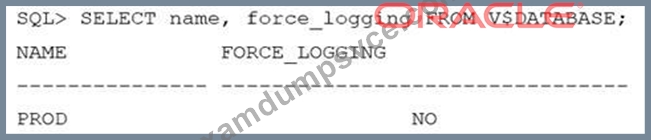
You issue the following command to import tables into the hr schema:
$ > impdp hr/hr directory = dumpdir dumpfile = hr_new.dmp schemas=hr
TRANSFORM=DISABLE_ARCHIVE_LOGGING: Y
Which statement is true?
- A. Only CREATE INDEX and CREATE TABLE statements generated by the import are logged.
- B. All database operations performed by the impdp command are logged.
- C. None of the operations against the master table used by Oracle Data Pump to coordinate its activities are logged.
- D. Only CREATE TABLE and ALTER TABLE statements generated by the import are logged.
Answer: D
Explanation:
Oracle Data Pump disable redo logging when loading data into tables and when creating indexes.
The new TRANSFORM option introduced in data pumps import provides the flexibility to turn off the redo generation for the objects during the course of import.
The Master Table is used to track the detailed progress information of a Data Pump job.
The Master Table is created in the schema of the current user running the Pump Dump export or import, and it keeps tracks of lots of detailed information.
NEW QUESTION 103
You notice that the elapsed time for an important database scheduler Job is unacceptably long.
The job belongs to a scheduler job class and window.
Which two actions would reduce the job's elapsed time?
- A. Increasing the priority of the job class to which the job belongs
- B. Increasing the job's relative priority within the Job class to which it belongs
- C. Increasing the priority of the scheduler window to which the job belongs
- D. Moving the job to an existing higher priority scheduler window with the same schedule and duration
- E. Increasing the resource allocation for the consumer group mapped to the scheduler job's job class within the plan mapped to the scheduler window
- F. Increasing the value of the JOB_QUEUE_PROCESSES parameter
Answer: C,E
Explanation:
http://www.dbaoracle.com/job_scheduling/job_classes.htmhttp://docs.oracle.com/database/121/ADMIN/schedove r.htm#i1106396
NEW QUESTION 104
You conned using SQL Plus to the root container of a multitenant container database (CDB) with SYSDBA privilege.
The CDB has several pluggable databases (PDBs) open in the read/write mode.
There are ongoing transactions in both the CDB and PDBs.
What happens alter issuing the SHUTDOWN TRANSACTIONAL statement?
- A. The shutdown proceeds as soon as all transactions in the CDB are either committed or
rolled back. - B. The shutdown proceeds as soon as all transactions in both the CDB and PDBs are
either committed or rolled back. - C. The shutdown proceeds immediately.
The shutdown proceeds as soon as all transactions in the PDBs are either committed or
rolled hack. - D. The statement results in an error because there are open PDBs.
Answer: A
Explanation:
*SHUTDOWN [ABORT | IMMEDIATE | NORMAL | TRANSACTIONAL [LOCAL]]
Shuts down a currently running Oracle Database instance, optionally closing and dismounting a database. If the current database is a pluggable database, only the pluggable database is closed. The consolidated instance continues to run.
Shutdown commands that wait for current calls to complete or users to disconnect such as SHUTDOWN NORMAL and SHUTDOWN TRANSACTIONAL have a time limit that the SHUTDOWN command will wait. If all events blocking the shutdown have not occurred within the time limit, the shutdown command cancels with the following message:
ORA-01013: user requested cancel of current operation *If logged into a CDB, shutdown closes the CDB instance.
To shutdown a CDB or non CDB, you must be connected to the CDB or non CDB instance that you want to close, and then enter SHUTDOWN
Database closed. Database dismounted. Oracle instance shut down.
To shutdown a PDB, you must log into the PDB to issue the SHUTDOWN command.
SHUTDOWN
Pluggable Database closed.
Note:
*Prerequisites for PDB Shutdown
When the current container is a pluggable database (PDB), the SHUTDOWN command
can only be used if:
The current user has SYSDBA, SYSOPER, SYSBACKUP, or SYSDG system privilege.
The privilege is either commonly granted or locally granted in the PDB.
The current user exercises the privilege using AS SYSDBA, AS SYSOPER, AS
SYSBACKUP, or AS SYSDG at connect time.
To close a PDB, the PDB must be open.
NEW QUESTION 105
What is the result of executing a TRUNCATE TABLE command on a table that has Flashback Archiving enabled?
- A. The rows in the table are truncated without being archived.
- B. The rows in both the table and the archive are truncated.
- C. It fails with the ORA-665610 Invalid DDL statement on history-tracked message
- D. The rows in the table are archived, and then truncated.
Answer: D
Explanation:
http://surachartopun.com/2010/06/ddl-on-tables-enabled-for-flashback.html
NEW QUESTION 106
You are about to plug a multi-terabyte non-CDB into an existing multitenant container database (CDB).
The characteristics of the non-CDB are as follows:
* Version: Oracle Database 11g Release 2 (11.2.0.2.0) 64-bit
* Character Set: AL32UTF8
* National Character Set: AL16UTF16
* O/S: Oracle Linux 6 64-bit
The characteristics of the CDB are as follows:
* Version: Oracle Database 12c Release 1 64-bit
* Character Set: AL32UTF8
* National Character Set: AL16UTF16
* O/S: Oracle Linux 6 64-bit
Which technique should you use to minimize down time while plugging this non-CDB into the CDB?
- A. Transportable database
- B. RMAN
- C. Data Pump full export/import
- D. Transportable tablespace
- E. The DBMS_PDB package
Answer: D
Explanation:
Explanation
Transportable tablespaces were introduced in Oracle 8i to allow whole tablespaces to be copied between databases in the time it takes to copy the datafiles. It is supported in Oracle 11g.
NEW QUESTION 107
Which three statements are true regarding the use of the Database Migration Assistant for Unicode (DMU)?
(Choose three.)
- A. The release of the database to be converted can be any release since 9.2.0.8.
- B. The DMU can report columns that are too long in the converted characterset.
- C. The DMU can report columns that are not represented in the converted characterset.
- D. A DBA can check specific tables with the DMU.
- E. The database to be migrated must be opened read-only.
Answer: B,C,D
Explanation:
Explanation
A: In certain situations, you may want to exclude selected columns or tables from scanning or conversion steps of the migration process.
D: Exceed column limit
The cell data will not fit into a column after conversion.
E: Need conversion
The cell data needs to be converted, because its binary representation in the target character set is different than the representation in the current character set, but neither length limit issues nor invalid representation issues have been found.
* Oracle Database Migration Assistant for Unicode (DMU) is a unique next-generation migration tool providing an end-to-end solution for migrating your databases from legacy encodings to Unicode.
NEW QUESTION 108
Examine the query and its output executed In an RDBMS Instance:
Which three statements are true about the users (other than sys) in the output?
- A. The C # # C_ADMIN user can perform the data guard operation with Data Guard Broker.
- B. The C # # B_ADMIN user can perform all backup and recovery operations using RMAN only.
- C. The C # # A_ADMIN user can perform wallet operations.
- D. The C # # D_ADMIN user can perform backup and recovery operations for Automatic Storage Management (ASM).
- E. The C # # B_ADMIN user can perform all backup and recovery operations using RMAN or SQL* Plus.
Answer: A,D,E
Explanation:
B: SYSDG administrative privilege has ability to perform Data Guard operations (including startup and shutdown) using Data Guard Broker or dgmgrl.
D: SYSASM The new (introduced in 11g) SYSASM role to manage the ASM instance, variable extent sizes to reduce shared pool usage, and the ability of an instance to read from a specific disk of a diskgroup
E (Not A): SYSDBA is like a role in the sense that it is granted, but SYSDBA is a special built-in
privilege to allow the DBA full control over the database
Incorrect:
Not C: SYSKM. SYSKM administrative privilege has ability to perform transparent data encryption
wallet operations.
Note:
Use the V$PWFILE_USERS view to see the users who have been granted administrative
privileges.
NEW QUESTION 109
Which four actions are possible during an Online Data file Move operation?
- A. Performing Block Media Recovery for a data block in the data file being moved
- B. Performing file shrink of the data file being moved
- C. Querying tables in the data file being moved
- D. Flashing back the database
- E. Creating and dropping tables in the data file being moved
- F. Executing DML statements on objects stored in the data file being moved
Answer: C,D,E,F
Explanation:
- You can now move On line Datafile without hove to stop Monoged Recovery and manually copy and rename Files. This can even be used to move Datafiles from or to ASM.
-New in Oracle Database 12c: FROM METAUNK. Physical Standby Database is in Active Data Guard Mode (opened READ ONLY and Managed Recovery is running): It is now possible to online move a Datafile while Managed Recovery is running, ie. the Physical Standby Database is in Active Data Guard Mode. You con use this Command to move the Datafile
-A flashback operation does not relocate a moved data file to its previous location. If you move a data file online from one location to another and later flash back the database to a point in time before the move, then the Data file remains in the new location, but the contents of the Data file ore changed to the contents at the time specified in the flashback. Oracle0 Database Administrator's Guide 12c Release 1 (12.1)
NEW QUESTION 110
Your multitenant container (CDB) contains two pluggable databases(PDB), HR_PDB and ACCOUNTS_PDB, both of which use the CDB tablespace. The temp file is called temp01.tmp.
A user issues a query on a table on one of the PDBs and receives the following error:
ERROR at line 1:
ORA-01565: error in identifying file '/u01/app/oracle/oradata/CDB1/temp01.tmp'
ORA-27037: unable to obtain file status
Identify two ways to rectify the error.
- A. Shut down the database instance and then restart the CDB and PDBs.
- B. Add a new temp file to the temporary tablespace and drop the temp file that that produced the error.
- C. Shutdown the database instance, restore and recover the temp file from the backup, and then open the database with RESETLOGS.
- D. Shut down the database instance, restore the temp01.tmp file from the backup, and then restart the database.
- E. Take the temporary tablespace offline, recover the missing temp file by applying redo logs, and then bring the temporary tablespace online.
Answer: A,E
Explanation:
* Because temp files cannot be backed up and because no redo is ever generated for them, RMAN never restores or recovers temp files. RMAN does track the names of temp files, but only so that it can automatically re-create them when needed.
*If you use RMAN in a Data Guard environment, then RMAN transparently converts primary control files to standby control files and vice versa. RMAN automatically updates file names for data files, online redo logs, standby redo logs, and temp files when you issue RESTORE and RECOVER.
NEW QUESTION 111
In a recent Automatic Workload Repository (AWR) report for your database, you notice a high number of buffer busy waits. The database consists of locally managed tablespaces with free list managed segments.
On further investigation, you find that buffer busy waits is caused by contention on data blocks.
Which option would you consider first to decrease the wait event immediately?
- A. Increasing the number of DBWNprocess
- B. Increasing db_buffer_cache based on the V$DB_CACHE_ADVICE recommendation
- C. Using Automatic Segment Space Management (ASSM)
- D. Decreasing PCTFREE
- E. Decreasing PCTUSED
Answer: C
Explanation:
*Automatic segment space management (ASSM) is a simpler and more efficient way of managing space within a segment. It completely eliminates any need to specify and tune the pctused,freelists, and freelist groups storage parameters for schema objects created in the tablespace. If any of these attributes are specified, they are ignored. *Oracle introduced Automatic Segment Storage Management (ASSM) as a replacement for traditional freelists management which used one-way linked-lists to manage free blocks with tables and indexes. ASSM is commonly called "bitmap freelists" because that is how Oracle implement the internal data structures for free block management.
Note:
* Buffer busy waits are most commonly associated with segment header contention onside
the data buffer pool (db_cache_size, etc.).
*The most common remedies for high buffer busy waits include database writer (DBWR)
contention tuning, adding freelists (or ASSM), and adding missing indexes.
NEW QUESTION 112
Your database supports an online transaction processing (OLTP) workload on an SMP machine.
The database is stored in ASM.
Examine these initialization parameters.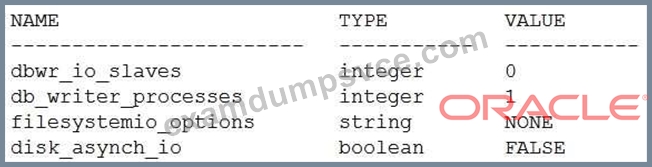
Applications are update intensive using indexed access and modified blocks are written in batches by the DBWR process.
You notice a large number of free buffer waitsand increase the size of the buffer cache, but eventually the same waits occur.
Which two actions would you recommend? (Choose two.)
- A. configure asynchronous I/O
- B. decrease the size of the buffer cache
- C. configure multiple DBWn processes
- D. configure I/O slaves for the DBWR process
- E. modifying the ASM disk for the database to use high redundancy
Answer: B,D
Explanation:
Explanation/Reference: https://docs.oracle.com/cd/B16240_01/doc/doc.102/e16282/oracle_database_help/ oracle_database_wait_bottlenecks_free_buffer_waits_pct.html
NEW QUESTION 113
In your Oracle 12c database, you create two roles: AUDITORand AUDIT_ADMIN. You then execute the following commands:
To create a privilege analysis policy for the AUDIT_ADMINrole, you execute the following PL/SQLblock: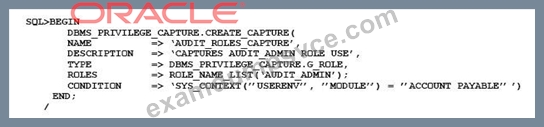
Which statement is correct about the procedure?
- A. It always captures the use of the CREATE VIEW and CREATE TABLE privileges.
- B. It always captures the use of the privileges exercised through the AUDITORand AUDIT_ADMIN roles.
- C. It captures the use of the privileges used through the AUDIT_ADMIN and AUDITORroles when the ACCOUNT PAYABLEmodule is used.
- D. It only captures the use of the privileges used through the AUDIT_ADMIN role when the ACCOUNT PAYABLE module is used.
Answer: D
Explanation:
Explanation/Reference:
References: https://docs.oracle.com/database/121/DVADM/priv_analysis.htm#DVADM591
NEW QUESTION 114
Which two statements are true about Enterprise Manager (EM) express in Oracle Database 12c? (Choose two.)
- A. You cannot start up or shut down a database instance by using EM express.
- B. By default, EM express is available for a database after database creation.
- C. Multiple databases on the same node (or host) may each be individually managed by using EM Express.
- D. You can perform basic administrative tasks for pluggable databases by using the EM express interface.
- E. You can create and configure pluggable databases by using EM express.
Answer: A,C
Explanation:
O12c is integrated in database don't have his own agent like in O11G then you cannot start up or shut down a database.
NEW QUESTION 115
A redaction policy was added to the SALcolumn of the SCOTT.EMPtable: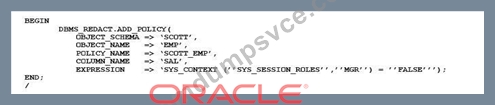
All users have their default set of system privileges.
For which three situations will data not be redacted? (Choose three.)
- A. SYSTEM session, only if the MGR role is set in the session
- B. SYSTEM sessions, regardless of the roles that are set in the session
- C. SCOTT sessions, only if the MGR role is granted to SCOTT
- D. SCOTT sessions, because he is the owner of the table
- E. SCOTT sessions, only if the MGR role is set in the session
- F. SYS sessions, regardless of the roles that are set in the session
Answer: B,C,F
Explanation:
http://docs.oracle.com/cd/E16655_01/network.121/e17729/redaction.htm#ASOAG594
NEW QUESTION 116
......
New 2022 1Z0-060 Test Tutorial (Updated 205 Questions): https://www.examdumpsvce.com/1Z0-060-valid-exam-dumps.html
