

Free 2024 Adobe Commerce AD0-E722 dumps are available on Google Drive shared by ExamDumpsVCE
Welcome to download the newest ExamDumpsVCE AD0-E722 PDF dumps: https://www.examdumpsvce.com/AD0-E722-valid-exam-dumps.html ( 52 Q&As)
Adobe AD0-E722 Exam Syllabus Topics:
| Topic | Details |
|---|---|
| Topic 1 |
|
| Topic 2 |
|
| Topic 3 |
|
| Topic 4 |
|
| Topic 5 |
|
NEW QUESTION # 16
An Adobe Commerce Architect needs to ensure zero downtime during the deployment process of Adobe Commerce on-premises. Which two steps should the Architect follow? (Choose two.)
- A. Enable Config flag Under developer/zero_down_time/enabled
- B. Run bin/magento setup:upgrad --convert-old-scripts-true to Upgrade database
- C. Enable Config flag Under deployement/blue_green/enabled
- D. Run bin/magento setup:upgrade - -keep-generated to Upgrade database
- E. Run bin/magento setup:upgrade --dry-run=true to upgrade database
Answer: C,D
Explanation:
Explanation
Option A is correct because enabling the config flag under deployment/blue_green/enabled is one of the steps to ensure zero downtime during the deployment process of Magento 2 on-premises. This flag enables the blue-green deployment feature, which allows deploying a new version of the Magento application to a separate environment (blue) without affecting the current live environment (green). Once the new version is ready, the traffic can be switched from green to blue with minimal or no downtime1.
Option C is correct because running bin/magento setup:upgrade --keep-generated is another step to ensure zero downtime during the deployment process of Magento 2 on-premises. This command updates the database schema and data without deleting the generated code and static view files. This way, the Magento application can still serve requests from the cache while the database is being upgraded2.
Option B is incorrect because running bin/magento setup:upgrade --dry-run=true does not upgrade the database, but only checks if there are any errors or conflicts in the database schema or data. This command can be used for testing purposes, but it does not affect the deployment process or the downtime3.
Option D is incorrect because there is no such option as --convert-old-scripts-true for the bin/magento setup:upgrade command. This option does not exist in Magento 2 and does not have any effect on the deployment process or the downtime.
Option E is incorrect because there is no such config flag as developer/zero_down_time/enabled in Magento 2. This flag does not exist in Magento 2 and does not have any effect on the deployment process or the downtime.
References:
1: Blue-green deployment | Adobe Commerce Developer Guide
2: Deploy Magento to production | Adobe Commerce Developer Guide
3: Command-line installation options | Adobe Commerce Developer Guide
NEW QUESTION # 17
A client is migrating to Adobe Commerce Cloud and has approximately 800 existing redirects that must be implemented. The number of redirects cannot be reduced because all redirects are specific, and do not match any pattern.
How should the redirects be configured to ensure performance?
- A. Add each redirect in the magento/routes.yaml file.
- B. Add each redirect as a URL rewrite via the admin Ul.
- C. Use VCL snippets to offload the redirect to Fastly.
Answer: C
NEW QUESTION # 18
An Adobe Commerce Architect is troubleshooting an issue on an Adobe Commerce Cloud project that is not yet live.
The developers copied the Staging Database to Production in readiness to Go Live. However, when the developers test their Product Import feature, the new products do not appear on the front end.
The developers suspect the Varnish Cache is not being cleared. Staging seems to work as expected. Production was working before the database migration.
What is the likely cause?
- A. Thefatlycredentials in the Production Database are incorrect.
- B. The site URLs in the Production Database are the URLs of the Staging Instance and must be updated
- C. A deployment should have been done on Production to initialize Fatly caching.
Answer: B
NEW QUESTION # 19
Since the last production deployment, customers can not complete checkout.
The error logs show the following message multiple times:
main.CRITICAL: Report ID: webapi-61b9fe83f0c3e; Message: Infinite loop detected, review the trace for the looping path The Architect finds a deployed feature that should limit delivery for some specific postcodes.
The Architect sees the following code deployed in etc/webapi_rest/di. xml and etc/frontend/di. Xml
LimitRates.php: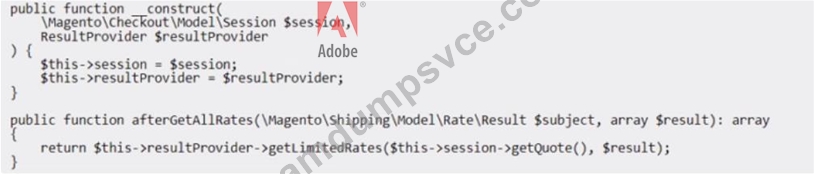
Which step should the Architect perform to solve the issue?
- A. Replace the injected dependency Of \Magento\Checkout\Model\Session With
\Magento\FraBievork\Session\SessionManagerInterf ace - B. Change 'after' plugin with 'around' plugin. The issue is being caused by calling the result provider code after the code of the original method.
- C. Inject an instance Of Magento\(Quote\Api\CartRepositoryInterface and receive Cart instance Via
$thiscartRepository->get($this->session->getQuoteId())
Answer: C
NEW QUESTION # 20
An Architect agrees to improve company coding standards and discourage using Helper classes in the code by introducing a new check with PHPCS.
The Architect creates the following:
* A new composer package under the AwesomeAgency\CodingStandard\ namespace
* The ruleset. xml file extending the Magento 2 Coding Standard
What should the Architect do to implement the new code rule?
- A.

- B.

- C.

Answer: B
Explanation:
Explanation
Option C is correct because adjusting the ruleset.xml file with the new rule is the simplest and most effective way to implement the new code rule. The ruleset.xml file defines the coding standards that are applied by PHP_CodeSniffer. By extending the Magento 2 Coding Standard and adding a new rule, the Architect can customize the code analysis and enforce the company coding standards. The new rule can use the Magento2.Namespaces.ForbiddenNamespaces sniff to check for any usage of Helper classes in the code and report them as errors or warnings1.
Option A is incorrect because creating a new composer package under the AwesomeAgency\CodingStandard\ namespace is not enough to implement the new code rule. The composer package is just a way to distribute and install the coding standard, but it does not define the rules themselves. The Architect still needs to create a ruleset.xml file and register it with PHP_CodeSniffer2.
Option B is incorrect because creating a new class
\AwesomeAgency\CodingStandard\Ruleset\ForbiddenNamespaces and specifying the rule inside the process method is unnecessary and complicated. The Architect does not need to create a new class or a new sniff for this rule, as there is already an existing sniff in the Magento 2 Coding Standard that can be used for this purpose. The Magento2.Namespaces.ForbiddenNamespaces sniff can be configured with an include-pattern element to specify which namespaces are forbidden1.
References:
1: Magento 2 Coding Standards | Adobe Commerce Developer Guide
2: How to create a custom coding standard | PHP_CodeSniffer Documentation
NEW QUESTION # 21
An Adobe Commerce Architect is investigating a case where some EAV product attributes are no longer updated.
* The catalog is composed of 20.000 products with 100 attributes each.
* The product updates are run by recurring Adobe commerce imports that happen multiple times a day.
* The Architect finds an error in the logs that indicates an integrity constraint while trying to insert row with id
2147483647.
What is causing this error?
- A. Magento framework uses INSERT on DUPLICATE, which leads to reaching the max limit of the increment of the column.
- B. Integrity constraints were dropped after upgrading to the latest version, and the integrity checks were missed.
- C. EAV attribute import uses REPLACE, which leads to reaching the max limit of the increment of the column
Answer: C
Explanation:
Explanation
EAV attribute import uses the REPLACE statement, which deletes and inserts a new row with the same primary key value. This causes the auto-increment column to increase by one for each row, even if the row already exists. If the auto-increment column reaches its maximum value, which is 2147483647 for a signed INT, then any further REPLACE statement will fail with an integrity constraint violation error. References:
EAV and extension attributes | Magento 2 Developer Documentation
GitHub - techdivision/import-attribute: This library provides the functionality for the Magento 2 import of EAV attributes Data integrity in JSON (B) when replacing EAV - Stack Overflow
NEW QUESTION # 22
An Adobe Commerce Architect creates a stopword for the Italian locale named stopwordsjtJT.csv and changes the stopword directory to the following: <magento_root>/app/code/Customvendor/Elasticsearch/etc/stopwords/ What is the correct approach to change the stopwords directory inside the custom module?
- A. Add stopwords to the stopwordsDirectory parameter of the\Hagento\Elasticsearch\Model\Adapter\Document\DirectoryBuilder ClaSS Via stopwords/it.xml and Adobe Commerce will automatically detect the current module.
- B. Add stopwords to the stopwordsDirectory and CustomerVendor_Elasticsearch to the stopword sModule parameter Of the \Magento\Elasticsearch\SearchAdapter\Query\Preprocessor\Stopwords ClflSS Via di.xml
- C. Add a new ClaSS implementing \Magento\Framework\Setup\Patch\PatchInterface to modify the default Value Of elasticsearch\customer\stopwordspath in core.conf ig_data table.
Answer: B
Explanation:
Explanation
According to the Adobe Commerce documentation, the correct approach to change the stopwords directory inside a custom module is to use dependency injection to override the default values of the stopwordsDirectory and stopwordsModule parameters of the
\Magento\Elasticsearch\SearchAdapter\Query\Preprocessor\Stopwords class. The stopwordsDirectory parameter specifies the relative path of the stopwords directory from the module directory, while the stopwordsModule parameter specifies the name of the module that contains the stopwords directory. By adding these parameters to the di.xml file of the custom module, the Architect can change the location of the stopwords files without modifying the core code or database.
References:
To change the directory from your module
Configure Elasticsearch stopwords
NEW QUESTION # 23
An Adobe Commerce Architect designs and implements functionality that introduces a new Complex Product Type to the existing Adobe Commerce website. Besides visual demonstration of the new product type, the changes include adjustments to the price index.
The website utilizes a multi-dimensional indexer feature to store the price index. The Architect decides to cover it with integration tests. After creating and running one test, the Architect discovers that database storage is not being fully cleaned.
The test method has the following annotation declaration: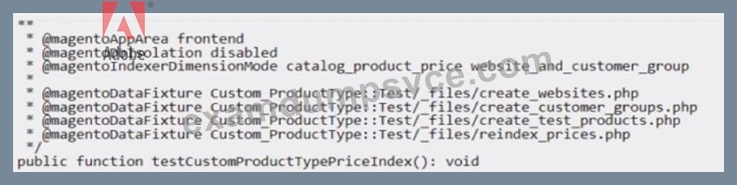
Which adjustment should the Architect make to fix this issue?
- A. Create Customer_ProductType: :Test/_files/{fixture_name)_rollback.php for every fixture
- B. Modify method PHPDoc and change annotation @magentoDbIsolation to enabled
- C. Add annotation @magentoApplsolation enabled to method PHPDoc
Answer: B
Explanation:
Explanation
The issue here is that the database storage is not being fully cleaned after the test is run. The solution is to modify the method PHPDoc and change the annotation @magentoDbIsolation to enabled. This will ensure that the database storage is fully cleaned after the test is run. References:
https://developer.adobe.com/commerce/testing/guide/integration/#database-isolation1
NEW QUESTION # 24
An Architect working on a headless Adobe Commerce project creates a new customer attribute named my_attribute. Based on the attribute value of the customer, the results of GraphQI queries are modified using a plugin. The frontend application is communicating with Adobe Commerce through Varnish by Fastly. which is already caching the queries that will be modified. The Adobe Commerce Fastly extension is installed, and no other modifications are made to the application.
Which steps should the Architect take to make sure the vcl_hash function of Varnish also considers the newly created attribute?
- A. Create a new ClaSS inheriting from
Magento\GraphQlCache\Model\CacheId\CacheIdFactorProvidftrInterface and returning the Value of my_attribute from the getFactorValuefunction and my_attribute from the getFactorName function. Then add this class through Dl to the idFactorProviders array ofMagento\GraphQlCache\Model\CacheId\CacheIdCalculator. - B. Createa new class inheriting from Magento\Framework\GraphQi\Query\Resolver\identityinterfaca and returning the value of my_attributefrom the getidentities function.
Then specify a ecache(cacheidentity: Path\\To\\identityclass) directive for each GraphQL query to include the newly created IdentityClass to each query that adds the cache tags for each customer. - C. Create a new class inheriting from Magento\customer\customerData\stctionSourceinterface and returning the value of my_attributefrom the getSectionData function. Then add thisClaSS through the sectionSourceMap array Of Magento\Customer\CustomerData\SectionPoolInterface.
Answer: A
Explanation:
Explanation
To make sure the vcl_hash function of Varnish considers the newly created attribute, the Architect needs to do the following steps:
Create a new class that implements the
Magento\GraphQlCache\Model\CacheId\CacheIdFactorProviderInterface interface. This interface defines two methods: getFactorName and getFactorValue. The getFactorName method should return the name of the attribute, in this case, my_attribute. The getFactorValue method should return the value of the attribute for the current customer, which can be obtained from the customer session or customer repository1.
Add this class to the idFactorProviders array of
Magento\GraphQlCache\Model\CacheId\CacheIdCalculator through dependency injection. The CacheIdCalculator is responsible for generating a cache ID for each GraphQL request based on the factors provided by the idFactorProviders. By adding the new class to this array, the Architect ensures that the cache ID will include the value of my_attribute1.
The cache ID is then used by Varnish to hash and lookup the cached response for each request. By including my_attribute in the cache ID, the Architect ensures that Varnish will serve different responses based on the attribute value of the customer2.
Magento_GraphQlCache module | Magento 2 Developer Documentation
Varnish caching | Adobe Commerce 2.4 User Guide - Magento
NEW QUESTION # 25
An Adobe Commerce store owner sets up a custom customer attribute "my.attribute".
An Architect needs to display additional content on the home page, which should display only to Customers with "my.attribute" of a certain value and be the same content for all of them. The website is running Full Page Cache.
With simplicity in mind, which two steps should the Architect take to implement these requirements? (Choose two.)
- A. Create a Customer Segment and use 'my.attribute' in the conditions
- B. Use customer-data JS library to retrieve "my.attribute" value
- C. Add a dynamic block with the content to the Home Page
- D. Add a custom block and a pHTML template with the content to the cmsjndexjndex.xml layout
- E. Add a new context value of "my_attribute" to Magento\Framework\App\Http\Context
Answer: C,E
Explanation:
Explanation
To display additional content on the home page based on a custom customer attribute, the Architect needs to do the following steps:
Add a new context value of "my_attribute" to Magento\Framework\App\Http\Context. This will allow the Full Page Cache to generate different versions of the page for customers with different values of
"my.attribute". The context value can be set using a plugin on the Magento\Customer\Model\Context class.
Add a dynamic block with the content to the Home Page. A dynamic block is a type of content block that can be configured to display only to specific customer segments or conditions. The Architect can use the 'my.attribute' in the conditions of the dynamic block and assign it to the Home Page in the Content > Blocks section of the Admin Panel. References:
Private content | Magento 2 Developer Documentation
Dynamic Blocks | Adobe Commerce 2.3 User Guide - Magento
NEW QUESTION # 26
An external system integrates functionality of a product catalog search using Adobe Commerce GraphQL API.
The Architect creates a new attribute my_attribute in the admin panel with frontend type select-Later, the Architect sees that Productlnterf ace already has the field my_attribute, but returns an Int value. The Architect wants this field to be a new type that contains both option id and label.
To meet this requirement, an Adobe Commerce Architect creates a new module and file etc/schema.graphqls that declares as follows:
After calling command setup:upgrade, the introspection of Productlnterface field my_attribute remains Int.
What prevented the value type of field my_attribute from changing?
- A. The Magento_CatalogGraphQI module occurs later in sequence than the Magento_GraphQI module and merging output of dynamic attributes schema reader overrides types declared in schema.graphqls
- B. The fields of Productlnterface are checked during processing schema.graphqls files. If they have a corresponding attribute, then the backendjype of product attribute is set for field type.
- C. The interface Productlnterface is already declared in Magento.CatalogGraphQI module. Extending requires use of the keyword extend before a new declaration of Productlnterface.
Answer: C
Explanation:
Explanation
According to the Adobe Commerce documentation, to extend an existing GraphQL interface, the keyword extend must be used before the interface name. This indicates that the new declaration is adding or modifying fields to the existing interface, rather than redefining it. If the keyword extend is omitted, the new declaration will be ignored and the original interface will be used. In this case, the Architect wants to change the type of the my_attribute field in the ProductInterface interface, which is already declared in the Magento.CatalogGraphQl module. Therefore, the Architect should use the keyword extend before declaring the ProductInterface interface in the schema.graphqlsfile of the custom module. This will allow the Architect to override the type of the my_attribute field from Int to MyAttributeType.
References:
Extend existing schema | Adobe Commerce Developer Guide
Schema language with GraphQL | Adobe Commerce
NEW QUESTION # 27
An Adobe Commerce Architect is working on a scanner that will pull prices from multiple external product feeds. The Architect has a list of vendors and decides to create new config file marketplace.feeds.xml.
Which three steps can the Architect take to ensure validation of the configuration files with unique validation rules for the individual and merged files? (Choose three.)
- A. Provide schema to validate a merged file.
- B. Provide schema to validate an individual file.
- C. Add the Uniform Resource Name to the XSD file in the config XML file.
- D. Implement validation rules in the Converter class for the Config Reader
- E. Create validation rules in marketplace.schema.xsd.
- F. Create a class that implements \Magento\Framework\Config\Datainterface.
Answer: A,B,E
Explanation:
Explanation
The Architect can take the following steps to ensure validation of the configuration files with unique validation rules for the individual and merged files:
Create validation rules in marketplace.schema.xsd. This file defines the structure and constraints of the XML elements and attributes for the marketplace.feeds.xml configuration file. The Architect can use this file to specify the required and optional elements, data types, values, and patterns for the configuration file.
Provide schema to validate a merged file. This schema is used to validate the final configuration file that is generated after merging all the individual configuration files from different modules. The Architect can use this schema to check the consistency and completeness of the merged configuration file.
Provide schema to validate an individual file. This schema is used to validate each individual configuration file from each module before merging them. The Architect can use this schema to check the syntax and validity of each configuration file.
References:
https://experienceleague.adobe.com/docs/commerce-cloud-service/user-guide/architecture/starter-architecture.htm
NEW QUESTION # 28
A merchant notices that product price changes do not update on the storefront.
The index management page in the Adobe Commerce Admin Panel shows the following:
* All indexes are set to 'update by schedule'
* Their status is 'ready'
* There are no items in the backlog
* The indexes were last updated 1 minute ago
A developer verifies that updating and saving product prices adds the relevant product IDs into the catalog_product_price_cl changelog table. Which two steps should the Architect recommend to the developer to resolve this issue? (Choose two.)
- A. Manually reindex the catalog_product_price index from the command line: bin/magento indexer:reindex catalog_product_price.
- B. Reduce the frequency of the cron job to 5 minutes so the items have more time to process.
- C. Invalidate the catalog_Product_price indexer in the Adobe Commerce Admin Panel so that it is fully reindexed next time the cron runs.
- D. Make sure that the version_id for the price indexer in the mview_state table is not higher than the last entry for the same column in the changelog table and re-synchronize.
- E. Make sure that no custom or third-party modules modify the changelog and indexing process.
Answer: D,E
Explanation:
Explanation
The issue here is that the product price changes are not reflected on the storefront, even though the indexes are set to update by schedule and there are no items in the backlog. This indicates that there might be some problem with the changelog and indexing process, which are responsible for tracking and applying the data changes to the index tables. Therefore, the Architect should recommend the developer to check if any custom or third-party modules interfere with the changelog and indexing process, and disable or fix them if needed.
Additionally, the Architect should recommend the developer to verify that the version_id for the price indexer in the mview_state table is consistent with the last entry for the same column in the changelog table, and re-synchronize them if they are out of sync. This will ensure that the indexer can process all the data changes correctly and update the index tables accordingly. References:
https://experienceleague.adobe.com/docs/commerce-admin/systems/tools/index-management.html?lang=en#cron
NEW QUESTION # 29
An Adobe Commerce Architect runs the PHP Mess Detector from the command-line interface using the coding standard provided with Adobe Commerce. The following output appears:
The Architect looks at the class and notices that the constructor has 15 parameters. Five of these parameters are scalars configuring the behavior of MyService. The class also contains three constants referencing one other class.
How should the Architect fix the code so that it complies with the coding standard rule?
- A. Introduce a new class accepting those five scalars and use it in the constructor and the remaining logic of MyService.
- B. Modify the code of MyService so that the number of different classes and interfaces referenced anywhere inside the class is fewer than 13.
- C. Consolidate the constants referencing other classes into a string representation.
Answer: A
Explanation:
Explanation
The issue is being caused by the high coupling between objects (CBO) value of the class MyService. CBO is a metric that measures the number of classes that are coupled to a given class, either by method calls, property or parameter references, inheritance, or constants1. A high CBO value indicates that the class is too tightly coupled with other classes, which makes it more difficult to maintain, test, and reuse2. To reduce the CBO value, the Architect should introduce a new class that encapsulates the five scalar parameters that configure the behavior of MyService. This way, the constructor of MyService will only have one parameter of the new class type, instead of five scalar parameters. This will also make the code more readable and maintainable, as the new class can provide methods to access and manipulate the configuration data. The constants referencing other classes should not be consolidated into a string representation, as this would not reduce the CBO value and would make the code less clear and type-safe3. The number of different classes and interfaces referenced anywhere inside the class is not relevant for the CBO metric, as it only counts the classes that are coupled to the given class1. References: CBO coupling between object, Coupling Between Object classes (CBO), Cohesion and coupling of an object in OO programming
NEW QUESTION # 30
While developing a new functionality for a website in developer mode with all cache types enabled, an Adobe Commerce Developer needs to add \Magento\Sales\Model\Service\InvoiceService SinvoiceService as a new dependency to an existing page action controller in Vendor\CustomModule\Controller\Index\Index . This is accomplished as follows:
After cleaning the f ull_page cache and reloading the page, the developer encounters the following exception:
Recoverable Error: Argument 2 passed to Vendor\CustomModule\Controller\Index\Index::__construct() must be an instance of
\Magento\Sales\Model\Service\InvoiceService [...]
Which action should the Architect recommend to the developer to fix this error?
- A. Remove the generated Child ClaSS from generated/code/Vendor/CustomModule/Controller/Index/Index.
- B. Add the new \Magento\sales\Model\service\invoiceService Sinvoiceservice dependency at the end of the constructor signature.
- C. Clean the block_html cache along with full_page cache.
Answer: A
Explanation:
Explanation
The error is caused by the generated child class not being updated with the new dependency. Removing the generated child class will allow the system to generate a new child class with the correct dependency. The generated child class is a proxy class that extends the original controller class and overrides the constructor to inject the dependencies using the object manager. The generated child class is created when the system runs in developer mode with cache enabled, to avoid performance issues. However, when a new dependency is added to the original controller class, the generated child class does not reflect the change and causes a mismatch in the constructor arguments. Therefore, deleting the generated child class from the generated/code directory will solve the problem.
References:
Generated code | Adobe Commerce Developer Guide
Constructor signature change | Adobe Commerce Developer Guide
NEW QUESTION # 31
A merchant is using a unified website that supports native Adobe Commerce B2B and B2C with a single store view.
The merchant's objective is to display the B2B account features, such as negotiable quotes and credit limits, in the header of the site on every page for logged-in users who belong to a B2B company account.
Each B2B company possesses its unique shared catalog and customer group, while numerous customer groups for non-B2B customers undergo changes. The merchant insists that this association should not be linked to customer groups.
Which two solutions should the Architect recommend for consideration, taking into account public data and caching? (Choose two.)
- A. Create a new custom condition for customer segments that allow for choosing whether a user is part of a B2B company and then use this segment to modify the output accordingly.
- B. Check if the current user is part of a B2B company within a block class and modify the output accordingly.
- C. Create a new HTTP Context variable to allow for separate public content to be cached for users in B2B companies where the output can be modified accordingly.
- D. Create a Virtual Type that switches the theme when a user is part of a B2B company so the output can be modified accordingly in the alternate theme.
- E. Set whether the current user is part of a B2B company in the customer session and use that data directly to modify the output accordingly.
Answer: A,C
Explanation:
Explanation
Option B is a valid solution because creating a new HTTP Context variable can allow for differentiating the public content cache for users who belong to a B2B company account. The HTTP Context variable can be used to modify the output of the header block accordingly, without affecting the performance or scalability of the site1 Option D is also a valid solution because creating a new custom condition for customer segments can enable targeting users who are part of a B2B company account. The customer segment can be used to modify the output of the header block accordingly, using layout updates or dynamic blocks. This solution can also leverage the existing customer segment functionality and avoid custom coding2 Option A is not a valid solution because switching the theme based on a virtual type can cause performance issues and increase the complexity of the site maintenance. Moreover, switching the theme can affect the entire site appearance, not just the header block3 Option C is not a valid solution because using the customer session data directly to modify the output of the header block can prevent the public content cache from working properly. The customer session data is private and cannot be cached, so this solution can negatively impact the performance and scalability of the site4 Option E is not a valid solution because checking if the current user is part of a B2B company within a block class can also prevent the public content cache from working properly. The block class logic is executed on every request, so this solution can negatively impact the performance and scalability of the site5 References:
1:
https://experienceleague.adobe.com/docs/commerce-cloud-service/user-guide/architecture/starter-architecture.htm
https://experienceleague.adobe.com/docs/commerce-cloud-service/user-guide/marketing/customer-segments.htm
https://experienceleague.adobe.com/docs/commerce-cloud-service/user-guide/design/themes.html?lang=en 4:
https://experienceleague.adobe.com/docs/commerce-cloud-service/user-guide/architecture/starter-architecture.htm
https://experienceleague.adobe.com/docs/commerce-cloud-service/user-guide/architecture/starter-architecture.htm
NEW QUESTION # 32
While reviewing a newly developed pull request that refactors multiple custom payment methods, the Architect notices multiple classes that depend on \Magento\Framework\Encryption\EncryptorInterface to decrypt credentials for sensitive data. The code that is commonly repeated is as follows: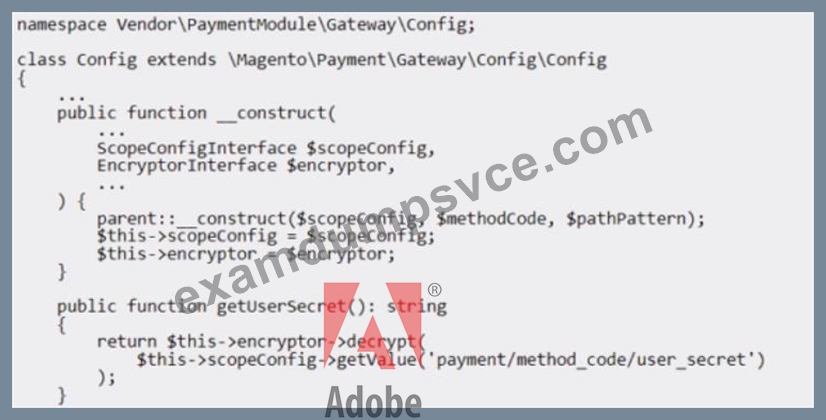
The Architect needs to recommend an optimal solution to avoid redundant dependency and duplicate code among the methods. Which solution should the Architect recommend?
- A. Add a plugin after the getvalue method of $scopeConfig, remove the $encryptor from dependency and use it in the plugin to decrypt the value if the config name is user.secret'
- B. Create a common config service class vendor\Pay-ient\Gateway\conf ig\conf ig under Vendor.Payment and use it as a parent class for all of the Vendor\PayimentModule\Gateway\Conf ig\Conf ig ClaSSeS and remove $scopeConf ig and Sencryptor dependencies
- C. Replace all Vendor\PaymentModule\Gateway\Config\Config ClaSSeS With virtualType Of Magento\Payiaent\Gateway\Conf ig\Conf ig and Set <user_secret backend_Model="Magento\Config\Model\Config\Backend\Encrypted" /> Under config.xml
Answer: C
Explanation:
Explanation
The Architect should recommend replacing all Vendor\PaymentModule\Gateway\Config\Config Classes with virtualType of Magento\Payment\Gateway\Config\Config and setting <user_secret backend_Model="Magento\Config\Model\Config\Backend\Encrypted" /> under config.xml. This will avoid redundant dependency and duplicate code among the methods. The virtualType of Magento\Payment\Gateway\Config\Config will inherit the functionality of the base class and allow the customization of the constructor arguments, such as the pathPattern and valueHandlerPool. The backend_Model attribute of the user_secret field will specify that the value of this field should be encrypted and decrypted by the Magento\Config\Model\Config\Backend\Encrypted class, which implements the
\Magento\Framework\App\Config\ValueInterface interface and uses the
\Magento\Framework\Encryption\EncryptorInterfaceinternally12. This way, the payment modules do not need to depend on the \Magento\Framework\Encryption\EncryptorInterface or the
\Magento\Framework\App\Config\ScopeConfigInterface directly, and can use the getValue method of the Magento\Payment\Gateway\Config\Config class to get the decrypted value of the user_secret field3.
References:
How to encrypt system configuration fields in Magento 2 - Mageplaza
Magento 2: How to Encrypt/Decrypt System Configuration Fields - Webkul Blog Magento 2: How to create custom payment method - BelVG Blog
NEW QUESTION # 33
An Architect needs to create an additional regional UK website with its own website currency set to GBP in Adobe Commerce. An existing US website is using USD as a default base and website currency.
After the first week of sales in the new UK website, an administrator notices that all sales totals in Sales Orders report show £0.00.
How should this issue be resolved?
- A. Configure currency rates for GBP and USD, so they are not empty.
- B. Make sure that orders are shipped and not left in processing state.
- C. Refresh Lifetime Statistics for "Total Invoiced'.
Answer: A
Explanation:
Explanation
The issue here is that the sales totals in Sales Orders report show £0.00 for the new UK website. This is because the currency rates for GBP and USD are not configured, so the system cannot convert the order amounts from GBP to USD. The solution is to configure the currency rates for GBP and USD, so they are not empty. This will allow the system to calculate the sales totals in USD for the report. References:
https://experienceleague.adobe.com/docs/commerce-admin/stores-sales/site-store/currency/currency-update.html
NEW QUESTION # 34
An Architect is investigating a merchant's Adobe Commerce production environment where all customer session data is randomly being lost. Customer session data has been configured to be persisted using Redis, as are all caches (except full page cache, which is handled via Varnish).
After an initial review, the Architect is able to replicate the loss of customer session data by flushing the Magento cache storage, either via the Adobe Commerce Admin Panel or running bin/magento cache: flush on the command line. Refreshing all the caches in the Adobe Commerce Admin Panel or running bin/magento cache: clean on the command line does not cause session data to be lost.
What should be the next step?
- A. Set the Stores > Configuration' option for Store Session Data Separately' to 'Yes' in the Adobe Commerce Admin Panel.
- B. Educate the merchant to not flush cache storage and only refresh the caches in future.
- C. Check app/etc/env.php and make sure that the Redis configuration for caches and session data use different database numbers.
Answer: C
Explanation:
Explanation
The issue here is that the customer session data is randomly being lost when flushing the Magento cache storage. This is because the Redis configuration for caches and session data might be using the same database number, which causes the session data to be deleted along with the caches. The solution is to check the app/etc/env.php file and make sure that the Redis configuration for caches and session data use different database numbers. This will prevent the session data from being affected by the cache operations. References:
https://experienceleague.adobe.com/docs/commerce-cloud-service/user-guide/develop/deploy/redis.html?lang=e
NEW QUESTION # 35
An Adobe Commerce Architect needs to customize the workflow of a monthly installments payment extension. The extension is from a partner who is contracted with the default website Payment Service Provider (PSP), which has its own legacy extension (a module using deprecated payment method).
The installment payment partner manages only initializing a payment, and then hands the capture to be executed by the PSP Once the amount is successfully captured, the PSP notifies the website through a webhook. The goal of the webhook is only to create an "invoice" and save the "capture information" to be used later for refund requests through the PSP itself.
The Architect needs the most simple solution to capture the requested behavior.
Which solution should the Architect implement?
- A. Declare a capture Command with type Magento\Payment\Gateway\Command\NullCommand for the payment method CommandPool in di.xml
- B. Change the can_capture attribute for the payment method under config.xml to be
<can_capture>0</can_capture> - C. Add a plugin before the $invoice->capture() and change Its input to prevent the call of the
$Payment->capture()
Answer: A
Explanation:
Explanation
Option C is the correct solution because declaring a capture command with type Magento\Payment\Gateway\Command\NullCommand for the payment method command pool in di.xml will prevent the default capture logic from being executed. The NullCommand class is a dummy implementation of the CommandInterface that does nothing. This way, the payment capture will be handled by the PSP webhook, and the invoice will be created accordingly12 Option A is not a correct solution because adding a plugin before the $invoice->capture() and changing its input to prevent the call of the $payment->capture() will require modifying the core Magento code, which is not recommended. Moreover, this solution will affect all payment methods that use the invoice capture logic, not just the monthly installments payment extension3 Option B is not a correct solution because changing the can_capture attribute for the payment method under config.xml to be <can_capture>0</can_capture> will disable the capture functionality for the payment method entirely. This means that the invoice cannot be created or captured, even by the PSP webhook4 References:
1:
https://experienceleague.adobe.com/docs/commerce-cloud-service/user-guide/payments-integrations/payment-ga
https://github.com/magento/magento2/blob/2.4-develop/app/code/Magento/Payment/Gateway/Command/NullCo
https://experienceleague.adobe.com/docs/commerce-cloud-service/user-guide/customization/best-practices.html?
https://experienceleague.adobe.com/docs/commerce-cloud-service/user-guide/payments-integrations/payment-ga
NEW QUESTION # 36
An Adobe Commerce Architect is supporting deployment and building tools for on-premises Adobe Commerce projects. The tool is executing build scripts on a centralized server and using an SSH connection to deploy to project servers.
A client reports that users cannot work with Admin Panel because the site breaks every time they change interface locale.
Considering maintainability, which solution should the Architect implement?
- A. Modify project config.php file, configure 'admin_locales_for_deploy' value, and specify all required locales
- B. Adjust the tools build script and specify required locales during *setup:static-content:deploy' command
- C. Edit project env.php file, configure 'adminJocales_for_build' value, and specify all required locales
Answer: B
Explanation:
Explanation
The issue here is that the site breaks every time the users change interface locale in the Admin Panel. This is because the static content for the different locales is not generated during the deployment process. The solution is to adjust the tools build script and specify required locales during *setup:static-content:deploy' command. This will ensure that the static content for all the needed locales is generated and deployed to the project servers. References:
https://experienceleague.adobe.com/docs/commerce-cloud-service/user-guide/develop/deploy/static-content.htm
NEW QUESTION # 37
......
Tested Material Used To AD0-E722: https://www.examdumpsvce.com/AD0-E722-valid-exam-dumps.html
Following are some new AD0-E722 Real Exam Questions!: https://drive.google.com/open?id=1sBQMirsBxAxTK1DbR_8tKRYUoReGDXaz
