

135 Exam Questions for MSP-Practitioner Updated Versions With Test Engine
Pass MSP-Practitioner Exam with Updated MSP-Practitioner Exam Dumps PDF 2026
NEW QUESTION # 16
Which of following is output of 'Identifying the programme'?
- A. Business Case
- B. Benefit profiles
- C. Programme Mandate
- D. Appointment of programme board and SRO
Answer: D
Explanation:
One key output of the 'Identifying the Programme' process is the appointment of the Programme Board and the Senior Responsible Owner (SRO). This formalizes the governance structure needed to provide leadership and oversight for the programme. The MSP Practitioner clearly states: "Programme board is set up by SRO in this process," highlighting that governance is established early to ensure accountability and decision-making capability is in place before the programme progresses further.
NEW QUESTION # 17
Which of the following is a KEY attribute for a Programme Manager?
- A. Have access to key stakeholders
- B. Have ongoing operational responsibilities within their business area
- C. Change management skills
- D. A good knowledge of project management approaches
Answer: D
Explanation:
A key attribute for a Programme Manager is a good knowledge of project management approaches. This expertise enables the Programme Manager to oversee and coordinate multiple interrelated projects, ensuring they deliver outputs that collectively realize programme objectives.
The MSP Practitioner states: "Programme Manager should have good project management skills," emphasizing that while strategic leadership and stakeholder engagement are important, the ability to manage the complexities of project delivery is fundamental to the Programme Manager role.
While change management skills and access to key stakeholders are important complementary abilities, the core responsibility of managing project delivery across a dossier of projects necessitates strong project management knowledge. The Programme Manager acts as the bridge between strategic programme objectives and tactical project execution, requiring detailed understanding of project methodologies, risk management, scheduling, resource coordination, and quality assurance.
This knowledge supports effective integration, issue resolution, and benefits delivery, positioning the Programme Manager as a central figure in programme success.
NEW QUESTION # 18
Which of the following will not be in Issue register?
- A. Description of issue
- B. How issues will be identified, captured and assessed
- C. Date issue was raised
- D. Categorization of issue
Answer: B
NEW QUESTION # 19
The programme is in the 'plan progressive delivery' process. The programme manager has recommended that the funds for the HR Work should come from a different source to the funding for the project work.
During which activity is the SRO responsible for providing formal approval for this recommendation?
- A. Prepare for the next process
- B. Continue to develop and validate programme plans
- C. Confirm business case
- D. Agree to proceed (or close)
Answer: D
Explanation:
Comprehensive and Detailed 200 to 250 words of Explanation From Exact Extract of project- programme-and-portfolio-management of 5th Edition MSP:
The 'Plan progressive delivery' process is where the detailed plans for the tranches and projects are finalized, and the financial requirements are clarified. This process bridges the gap between the initial design and the start of actual delivery. One of the final and most critical activities in this process (and indeed in most MSP processes) is 'Agree to proceed (or close)'.
In MSP 5th Edition, the Senior Responsible Owner (SRO) holds the ultimate authority to commit the organization to the investment. While the Programme Manager develops the recommendation for funding sources during the planning activities, the SRO must formally approve the entire package of plans, the budget, and the funding strategy before the programme can move into the delivery tranches. Option D is the correct answer because this specific activity represents the "gate" at the end of the planning process. By "agreeing to proceed," the SRO is providing the final authorization for the financial arrangements and the overall delivery strategy. This ensures that the SRO is fully satisfied with the justification and the resource commitments before any significant expenditure begins in Tranche 1. It is a fundamental governance checkpoint that ensures the SRO remains in control of the programme's viability and strategic alignment.
NEW QUESTION # 20
In which MSP theme would you expect to find the POTI model?
- A. Blueprint Design and Delivery
- B. Vision
- C. Planning and Control
- D. Leadership and Stakeholder Engagement
Answer: A
NEW QUESTION # 21
The Customer Processes Project has reported that the work to develop the integrated billing and accounting services is progressing according to plan. However, when the system was tested, the system performance was very slow and there are errors that were not previously identified. The programme manager is concerned about the possible impact of this inaccurate reporting.
Which type of data gathering should be improved, and why?
- A. Looking back: because the project's reporting focus should be upwards and outwards
- B. Looking forward, because the project should inform the programme of these disruptive trends
- C. Looking forward, because the programme should identify emerging risks from the wider context
- D. Looking back, because the project's reporting represents a risk to the overall programme delivery
Answer: D
Explanation:
Comprehensive and Detailed 200 to 250 words of Explanation From Exact Extract of project- programme-and-portfolio-management of 5th Edition MSP:
The Decisions Theme in MSP 5th Edition emphasizes the necessity of high-quality data to support effective governance and oversight. The framework distinguishes between two types of data gathering: "looking back" and "looking forward." Looking-back data focuses on monitoring the performance of the programme and its constituent projects against their approved plans (e.g., progress, cost, quality, and risk status).
In this scenario, there is a disconnect between the project's status report ("progressing according to plan") and the actual technical reality (slow performance and errors). This is a failure of looking-back data. Option B is the correct answer because the programme manager needs to improve the accuracy of reporting on work already completed or in progress. Without reliable "looking-back" information, the programme board cannot identify variances or risks to the overall delivery schedule. Inaccurate reporting masks technical debt and quality issues, which ultimately threatens the realization of benefits. While "looking forward" data (Options C and D) is important for scanning the external environment or identifying future trends, the immediate issue here is a failure to report current internal project health accurately. Improving looking-back data ensures that the programme has a "single version of the truth" regarding the capability being delivered, allowing for timely intervention and more robust decision-making.
NEW QUESTION # 22
During the 'plan progressive delivery' process, it was decided that the call centre managers would hold a weekly meeting with all call centre staff to update them on progress and understand any concerns that they might have. This information was documented by the programme manager.
Which theme is being applied?
- A. Design
- B. Organization
- C. Decisions
- D. Knowledge
Answer: D
Explanation:
Comprehensive and Detailed 200 to 250 words of Explanation From Exact Extract of project- programme-and-portfolio-management of 5th Edition MSP:
The Knowledge Theme in MSP 5th Edition is focused on the effective use of information to support the transformation. A major component of this theme is Stakeholder Engagement and the communication of information to ensure that the business is prepared for change. The Knowledge theme emphasizes that knowledge is not just about data; it is about the "flow" of information between the programme and those affected by it.
In this scenario, the weekly meetings are a mechanism for two-way communication. They serve to provide information (updates on progress) and to capture knowledge (understanding staff concerns). Option D is the correct answer because this activity is part of the programme's approach to managing knowledge and ensuring that the human element of the transformation is handled effectively. By documenting this in the Stakeholder Engagement Approach or a similar control document during the planning phase, the programme is ensuring that it has a structured way to share explicit knowledge and capture tacit feedback from the operational front line. This is essential for maintaining morale, identifying potential issues early, and ensuring that the "knowledge" of the business's readiness for change is fed back into the programme's decision-making processes.
NEW QUESTION # 23
Which of the following statements is NOT TRUE?
- A. The SRO is accountable for the Programme Brief.
- B. The Programme Manager is responsible for the Vision Statement.
- C. The SRO is accountable for confirming Programme Mandate.
- D. The Programme Manager is responsible for the Blueprint.
Answer: C
NEW QUESTION # 24
Which of the following statements is FALSE?
- A. The SRO is appointed by the Sponsoring Group.
- B. The SRO is likely to be a peer of the Sponsoring Group.
- C. The SRO acts as the Project Executive on all the Project Boards.
- D. The SRO must have enough seniority to take on accountability for the programme delivery.
Answer: C
NEW QUESTION # 25
As the influence of a stakeholder increases, it is recommended that a 'higher' level of engagement is appropriate. Which of the following describes this increasing engagement?
- A. Keep informed, active consultation, maintain interest
- B. Maintain interest, active consultation, keep informed
- C. Active consultation, keep informed, maintain interest
- D. Keep informed, maintain interest, active consultation
Answer: D
NEW QUESTION # 26
In which document would you expect to find the levels of confidentiality to be applied in the programme?
- A. The Resource Management Strategy
- B. The Benefits Management Strategy
- C. The Information Management Strategy
- D. The Quality Management Strategy
Answer: C
Explanation:
Levels of confidentiality and information security requirements are documented in the Information Management Strategy. This strategy sets out how information will be handled throughout the programme, covering aspects such as access rights, data classification, storage, and dissemination protocols to protect sensitive information.
The MSP Practitioner specifies: "Confidentiality details are defined in Information management strategy," indicating that this document governs the secure management of programme data and communication. It is essential that confidentiality levels are clear to prevent unauthorized access to sensitive information, which could jeopardize the programme's success or breach legal and regulatory obligations.
While Quality Management, Resource Management, and Benefits Management Strategies address different governance aspects such as assurance, resource allocation, and benefit realization, they do not primarily deal with confidentiality.
Information management is critical for stakeholder trust, compliance with legislation (e.g., GDPR), and safeguarding intellectual property or competitive advantage. Clear documentation in the Information Management Strategy ensures that all programme participants understand their responsibilities regarding confidentiality, promoting consistent and secure handling of data.
NEW QUESTION # 27
Here are three statements about the programme justification for the Smart Meter Programme. In which document should the statements be recorded?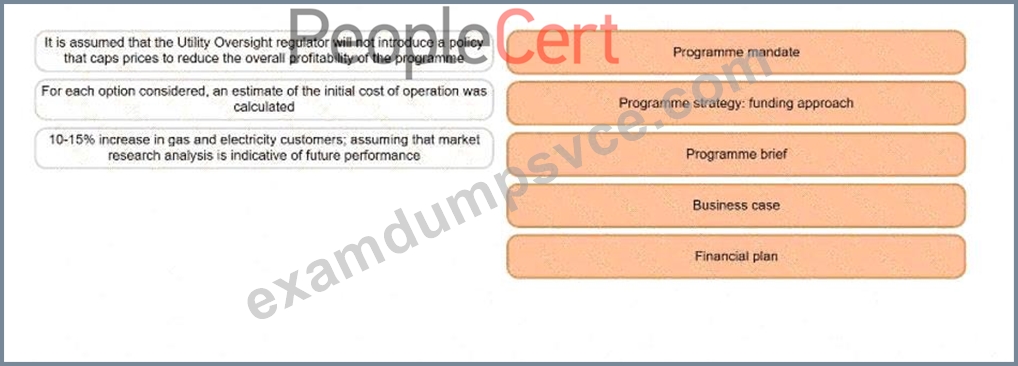
Answer:
Explanation: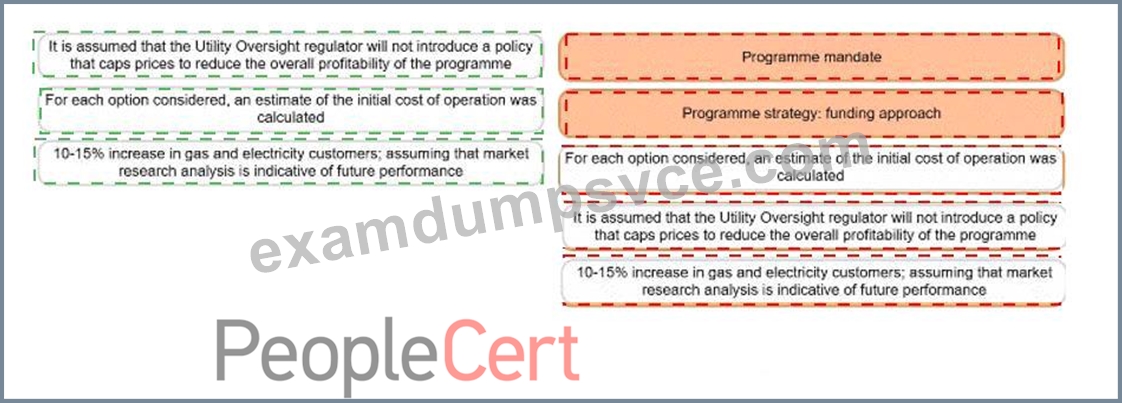
Explanation:
Statement
Document
It is assumed that the Utility Oversight regulator will not introduce a policy that caps prices to reduce the overall profitability of the programme Business case For each option considered, an estimate of the initial cost of operation was calculated Programme brief
10-15% increase in gas and electricity customers; assuming that market research analysis is indicative of future performance Financial plan Strategic assumptions that underpin the financial viability of the investment belong in the Business Case.
High-level options analysis and initial costings are features of the Programme Brief developed during
'Identify the Programme'. Specific growth targets and their financial impact are managed within the Financial Plan
NEW QUESTION # 28
Which of the following is not correct about 'Leading change'?
- A. Get approval from sponsoring group
- B. Appoint right people at right time
- C. Actively engage stakeholder
- D. Create novel solutions to problems
Answer: A
Explanation:
'Leading change' principle in MSP focuses on driving transformation through the right leadership, engaging stakeholders actively, and fostering innovative solutions. However, getting approval from the sponsoring group is not considered part of this principle but rather a responsibility addressed in programme organization under governance themes. Approval processes are formalized separately from the leadership approach.
NEW QUESTION # 29
Who is accountable for approval to proceed?
- A. Group of directors
- B. Programme board
- C. Sponsoring Group
- D. SRO
Answer: D
Explanation:
Although the Sponsoring Group formally gives the approval to proceed, the accountability for this approval rests with the Senior Responsible Owner (SRO). The MSP Practitioner notes: "Approval to proceed is always given by Sponsoring group on recommendation from SRO. SRO is accountable for it." This means the SRO takes responsibility for ensuring the programme is ready to move forward and manages the formal approval process through the Sponsoring Group.
NEW QUESTION # 30
Which of the following is an Information Baseline?
- A. Management
- B. All of above
- C. Governance
- D. Boundary
Answer: B
Explanation:
All three-Governance, Boundary, and Management-are defined as Information Baselines in MSP. An Information Baseline refers to essential information repositories and frameworks that support programme control and management.
The MSP Practitioner states: "All are defined information baselines," meaning that governance baselines set controls and accountability, boundary baselines define scope and limits, and management baselines cover operational details such as risks and issues.
Together, these baselines form a comprehensive information foundation, enabling effective oversight, coordination, and decision-making throughout the programme lifecycle.
Understanding and maintaining these baselines ensures transparency, consistency, and effective control over complex transformational programmes.
NEW QUESTION # 31
Where in the transformational flow would the Benefits Map normally be created?
- A. Defining a Programme
- B. Managing the Tranches
- C. Realizing the Benefits
- D. Identifying a Programme
Answer: A
NEW QUESTION # 32
Where in the transformational flow would the Benefits Map normally be created?
- A. Defining a Programme
- B. Managing the Tranches
- C. Realizing the Benefits
- D. Identifying a Programme
Answer: A
Explanation:
The Benefits Map is typically created during the 'Defining a Programme' phase of the transformational flow.
This map visually links programme outputs to expected benefits and outcomes, providing a clear picture of how the programme's work will realize its intended value.
The MSP Practitioner explains: "Benefits are identified and analyzed in Defining a programme," which highlights that the Benefits Map is a key planning tool used to understand dependencies, confirm benefit ownership, and ensure alignment with strategic objectives before detailed delivery begins.
Creating the Benefits Map at this stage supports informed decision-making and prioritization, as well as effective communication with stakeholders about how change initiatives contribute to strategic goals. It also serves as a baseline for benefits realization planning and tracking throughout programme delivery.
By defining and mapping benefits early, the programme can mitigate risks of misalignment or overlooked benefits, thereby improving chances of successful transformation and measurable value creation.
NEW QUESTION # 33
The programme is in the 'design the outcomes' process. One risk to the programme is that new and improved meter technology may be developed during implementation. This risk has been assessed as high probability and high impact and is therefore a high priority. The initial delivery approach proposes a phased roll-out of the meters so that the programme can exploit any new technology that emerges. The CTO has been appointed as the owner of this risk.
Is this appointment an appropriate application of the identify and prioritize risks' activity, and why?
- A. No, because the phased roll-out should be documented as landing points during the 'develop the target operating model' activity
- B. No, because the phased roll-out should be planned for as part of the 'develop programme plans' activity
- C. Yes, because this risk would impact on the expected increased number of gas and electricity customers
- D. Yes, because the exposure created by this risk warrants the appointment of a senior risk owner
Answer: D
Explanation:
Comprehensive and Detailed 200 to 250 words of Explanation From Exact Extract of project- programme-and-portfolio-management of 5th Edition MSP:
The Risk Theme in MSP 5th Edition requires that all identified risks (both threats and opportunities) are assigned to an appropriate owner. A Risk Owner is someone who has the authority and resources to manage the risk and who is accountable for ensuring that the chosen response is implemented effectively. The seniority of the risk owner should be proportional to the level of risk exposure.
In this scenario, the risk-potential technological obsolescence or the opportunity for better technology-is categorized as high probability and high impact. This represents a significant exposure for the programme.
Option A is the correct answer because MSP guidance states that high-priority risks that could fundamentally affect the programme's technical strategy or benefit realization should be owned by senior leaders. The Chief Technology Officer (CTO) is the ideal owner because they have the strategic oversight and technical authority to manage a risk related to "next-generation" smart meters. Appointing a senior executive ensures that the risk receives the necessary attention at the Programme Board level and that the phased roll-out strategy is technically sound and aligned with the organization's long-term technology roadmap. This demonstrates a mature application of risk management where accountability is placed at the level where the most impact can be made.
NEW QUESTION # 34
Which of below sentences describes Project Brief?
- A. Control framework for projects
- B. Control framework for programme
- C. List of all projects that will be part of programme
- D. Describes purpose, cost, time, performance requirements and constraints of a project
Answer: D
NEW QUESTION # 35
Which of the following is NOT an MSP Governance Theme?
- A. Quality Management
- B. Organization
- C. Learning from Experience
- D. Leadership and Stakeholder Engagement
Answer: C
NEW QUESTION # 36
Which of following is output of 'Defining the programme'?
- A. Programme preparation plan
- B. Programme Mandate
- C. Governance Baseline
- D. Benefits measures
Answer: C
Explanation:
One of the key outputs of the 'Defining the Programme' process is establishing the Governance Baseline. This baseline sets out the governance framework, including roles, responsibilities, controls, and decision-making structures that will apply throughout the programme lifecycle. Defining the governance baseline early ensures clear accountability and oversight, which is vital for managing complexity and risk in transformational change.
The MSP Practitioner explains that during 'Defining the Programme,' "Governance is baselined" to create a robust foundation for programme control. This process involves formalizing the authority of the Senior Responsible Owner (SRO), the programme board, and other governance roles, ensuring they are empowered to manage and oversee programme activities effectively. It also includes establishing reporting lines, approval mechanisms, and quality assurance controls to maintain programme integrity.
Without a clearly defined governance baseline, programmes risk poor decision-making, ambiguity in responsibility, and inconsistent oversight, which can lead to scope creep, misalignment with strategic goals, and failure to realize benefits. The governance baseline serves as a reference point against which programme performance and compliance can be measured, enabling corrective action when deviations occur.
In summary, the Governance Baseline is a critical control output that defines how the programme will be directed and controlled, safeguarding successful delivery and alignment with corporate strategy throughout the programme's life.
NEW QUESTION # 37
Who approves Business Case?
- A. Sponsoring Group
- B. SRO
- C. BCM
- D. Programme Manager
Answer: B
Explanation:
The Senior Responsible Owner (SRO) approves the Business Case and is accountable for ensuring it remains valid and aligned with strategic objectives.
The MSP Practitioner states: "SRO approves (as he is accountable for it)." This underscores the SRO's critical role in governing programme justification and ensuring investment decisions remain sound.
While the Sponsoring Group may endorse or sponsor the programme, formal accountability and approval for the Business Case rest with the SRO, ensuring clear responsibility for delivery against agreed benefits.
This accountability helps maintain control and confidence in programme investment and delivery.
NEW QUESTION # 38
Which document identifies appropriate milestones for benefit reviews?
- A. Business case
- B. Benefit realization plan
- C. Information management plan
- D. Quality and assurance plan
Answer: B
Explanation:
The Benefit Realization Plan identifies milestones for benefit reviews. This plan details when and how benefits will be measured, reviewed, and managed to ensure they are achieved as expected.
The MSP Practitioner explains: "Benefits management plan identifies benefit reviews to increase likelihood of success." Regular benefit reviews help detect issues early, enable corrective actions, and maintain stakeholder confidence.
This plan is crucial for monitoring benefit progress post-delivery, coordinating with business change activities, and ensuring benefits sustain over the long term. It aligns benefit tracking with programme stages and organizational priorities, enhancing accountability and transparency.
NEW QUESTION # 39
......
MSP-Practitioner Exam Dumps - Free Demo & 365 Day Updates: https://www.examdumpsvce.com/MSP-Practitioner-valid-exam-dumps.html
Free Sales Ending Soon - Use Real MSP-Practitioner PDF Questions: https://drive.google.com/open?id=1qxLOK2TP3ZZzw6AKbDQSvXnTdMuGZzU2
