

CT-AI Certification - The Ultimate Guide [Updated 2026]
CT-AI Practice Exam and Study Guides - Verified By ExamDumpsVCE
NEW QUESTION # 47
A local business has a mail pickup/delivery robot for their office. The robot currently uses a track to move between pickup/drop-off locations. When it arrives at a destination, the robot stops to allow a human to remove or deposit mail. The office has decided to upgrade the robot to include AI capabilities that allow the robot to perform its duties without a track, without running into obstacles, and without human intervention.
The test team is creating a list of new and previously established test objectives and acceptance criteria to be used in the testing of the robot upgrade. Which of the following test objectives will test an AI quality characteristic for this system?
- A. The robot must complete 99.99% of its deliveries each day
- B. The robot must recharge for no more than six hours a day
- C. The robot must evolve to optimize its routing
- D. The robot must record the time of each delivery which is compiled into a report
Answer: C
Explanation:
In the syllabus, theevolutioncharacteristic for AI-based systems means the ability of the system to evolve and adapt its behavior in response to changes in the environment or in its own performance:
"Evolution is the system's ability to change itself to adapt to new situations, different hardware, or a changing operational environment." (Reference: ISTQB CT-AI Syllabus v1.0, Section 2.3)
NEW QUESTION # 48
You are developing a "flower" ML model... Which of the following describes an objection that you can NEGLECT in your risk assessment?
Choose ONE option (1 out of 4)
- A. The possible outputs of the "leaf" and "flower" ML models are so different that reuse has few advantages over new development.
- B. The probability of misclassification of the ML model "flower" is higher when it is reused than when it is developed from scratch.
- C. The possible inputs for the 'leaf' and 'flower' ML models are so different that reuse has few advantages over new development.
- D. The classification behavior of the "flower" ML model is more difficult to understand when it is reused compared to when it is developed from scratch.
Answer: A
Explanation:
The ISTQB CT-AI syllabus explains that reusing pre-trained models is strongly related tosimilarity between the original task and the new task. Section1.8 - Pre-trained Models and Transfer Learningstates that reuse is effective when the new task is similar to the original one, such as adapting a cat-classifier to classify dog breeds. The syllabus warns about risks related toinput differences,data preparation inconsistencies, inherited shortcomings, andexplainability issues. These are legitimate objections (matching options A, B, and C) because large differences in image inputs or patterns can undermine transfer learning; misclassification risk can increase; and explainability often decreases when reusing pre-trained models .
However,output differences are NOT a valid concernhere. Both the leaf-based and flower-based ML models classifythe same plant species, meaning theiroutputs are identical. The syllabus does not identify output mismatch as a transfer-learning risk. Real risks concerninputs,bias inheritance,model transparency, andtraining differences-not output labels. Therefore, OptionDdescribes an objection that can be safely neglected, because output classes are the same and do not hinder reuse.
NEW QUESTION # 49
Which ONE of the following statements correctly describes the importance of flexibility for Al systems?
SELECT ONE OPTION
- A. Flexible Al systems allow for easier modification of the system as a whole.
- B. Al systems require changing of operational environments; therefore, flexibility is required.
- C. Al systems are inherently flexible.
- D. Self-learning systems are expected to deal with new situations without explicitly having to program for it.
Answer: A
Explanation:
Flexibility in AI systems is crucial for various reasons, particularly because it allows for easier modification and adaptation of the system as a whole.
AI systems are inherently flexible (A): This statement is not correct. While some AI systems may be designed to be flexible, they are not inherently flexible by nature. Flexibility depends on the system's design and implementation.
AI systems require changing operational environments; therefore, flexibility is required (B): While it's true that AI systems may need to operate in changing environments, this statement does not directly address the importance of flexibility for the modification of the system.
Flexible AI systems allow for easier modification of the system as a whole (C): This statement correctly describes the importance of flexibility. Being able to modify AI systems easily is critical for their maintenance, adaptation to new requirements, and improvement.
Self-learning systems are expected to deal with new situations without explicitly having to program for it (D): This statement relates to the adaptability of self-learning systems rather than their overall flexibility for modification.
Hence, the correct answer is C. Flexible AI systems allow for easier modification of the system as a whole.
Reference:
ISTQB CT-AI Syllabus Section 2.1 on Flexibility and Adaptability discusses the importance of flexibility in AI systems and how it enables easier modification and adaptability to new situations.
Sample Exam Questions document, Question #30 highlights the importance of flexibility in AI systems.
NEW QUESTION # 50
Which of the following is an example of overfitting?
- A. The model is missing relationships between the inputs and outputs
- B. The model discards data it considers to be noise or outliers
- C. The model is too simplistic for the data
- D. The model is not able to generalize to accommodate new types of data
Answer: D
Explanation:
The syllabus defines overfitting as:
"Overfitting is when the ML model learns the training data so well that it is unable to generalize to accommodate new data." This occurs when the model memorizes the training data, including noise, instead of learning the general patterns.
(Reference: ISTQB CT-AI Syllabus v1.0, Section 3.5.1, page 31 of 99)
NEW QUESTION # 51
Which of the following problems would best be solved using the supervised learning category of regression?
- A. Predicting shopper purchasing behavior based on the category of shopper and the positioning of promotional displays within a store
- B. Determining if an animal is a pig or a cow based on image recognition
- C. Determining the optimal age for a chicken's egg-laying production using input data of the chicken's age and average daily egg production for one million chickens
- D. Recognizing a knife in carry-on luggage at a security checkpoint in an airport scanner
Answer: C
Explanation:
The syllabus states:
"Supervised learning... divides problems into two categories: classification and regression. Regression is used when the problem requires the ML model to predict a numeric output, for example predicting the age of a person based on their habits." (Reference: ISTQB CT-AI Syllabus v1.0, Section 3.1.1, Page 26 of 99)
NEW QUESTION # 52
Which of the following statements about reinforcement learning is correct?
Choose ONE option (1 out of 4)
- A. The agent's training is based on a reward function that rewards successful attempts
- B. From experience, the agent learns theoptimal reward function
- C. The approach is suitable when the application doesnotrequire interaction with the environment
- D. The agent creates a model of the environment from labeled data during training
Answer: A
Explanation:
Section1.6.3 - Reinforcement Learningof the ISTQB CT-AI syllabus states that reinforcement learning (RL) is based on anagent interacting with an environment, performing actions, and receivingrewards or penalties. The core concept is thereward function, which guides the agent's learning process. The syllabus emphasizes that training in RL isdriven by rewards, and the agent aims to maximize cumulative reward over time. Therefore, OptionCdirectly reflects the correct description: the agent learns by being rewarded for successful actions .
Option A is incorrect because RL doesnotuse labeled data; that applies to supervised learning. Option B contradicts the syllabus definition: RL fundamentallyrequiresinteraction with the environment. Option D is incorrect because the reward function isdefined by humans, not learned by the agent; the agent learns apolicy
, not the reward function itself.
Thus, OptionCis the only statement consistent with RL as defined in the syllabus.
NEW QUESTION # 53
Which ONE of the following options is the MOST APPROPRIATE stage of the ML workflow to set model and algorithm hyperparameters?
SELECT ONE OPTION
- A. Data testing
- B. Deploying the model
- C. Evaluating the model
- D. Tuning the model
Answer: D
Explanation:
Setting model and algorithm hyperparameters is an essential step in the machine learning workflow, primarily occurring during the tuning phase.
Evaluating the model (A): This stage involves assessing the model's performance using metrics and does not typically include the setting of hyperparameters.
Deploying the model (B): Deployment is the stage where the model is put into production and used in real-world applications. Hyperparameters should already be set before this stage.
Tuning the model (C): This is the correct stage where hyperparameters are set. Tuning involves adjusting the hyperparameters to optimize the model's performance.
Data testing (D): Data testing involves ensuring the quality and integrity of the data used for training and testing the model. It does not include setting hyperparameters.
Hence, the most appropriate stage of the ML workflow to set model and algorithm hyperparameters is C. Tuning the model.
Reference:
ISTQB CT-AI Syllabus Section 3.2 on the ML Workflow outlines the different stages of the ML process, including the tuning phase where hyperparameters are set.
Sample Exam Questions document, Question #31 specifically addresses the stage in the ML workflow where hyperparameters are configured.
NEW QUESTION # 54
Which of the following is a problem with AI-generated test cases that are generated from the requirements?
- A. They are usually missing the expected results, so verification is difficult or must resort to only detecting significant failures
- B. They are slow and will usually not be able to execute in the time allowed
- C. They make debugging more complicated because the number of steps is usually high in order to induce the target failure
- D. They are defect-prone because they are unable to detect nuances in the requirements
Answer: A
Explanation:
The syllabus mentions a drawback of AI-generated test cases:
"AI-based test generation tools can generate test cases... However, unless a test model that defines required behaviors is used as the basis of the tests, this form of test generation generally suffers from a test oracle problem because the AI-based tool does not know what the expected results should be." (Reference: ISTQB CT-AI Syllabus v1.0, Section 11.3, page 78 of 99)
NEW QUESTION # 55
Which statement about AI-based test case generation is correct?
Choose ONE option (1 out of 4)
- A. AI-generated functional test cases typically result in poor requirements coverage.
- B. Expected results may not be available for AI-generated functional test cases.
- C. An AI-based system under test must not be used as a functional test oracle.
- D. A different test oracle is usually required for each AI-generated functional test case.
Answer: B
Explanation:
The ISTQB CT-AI syllabus indicates inSection 5.2 - AI for Testingthat AI-generated test cases may not come withpredefined expected results. This is because test-case generation methods-such as evolutionary algorithms, reinforcement learning, or clustering-based sampling-produceinputs, but the tester must still determine the correct outputs. Therefore, OptionCis correct: expected results may not be available, especially when AI produces novel or previously unseen input combinations.
Option A is incorrect: AI-based test generation can improve coverage by exploring large input spaces. Option B is incorrect because the need for oracles does not depend on whether the test case is AI-generated. Option D is incorrect because the syllabus allows using a model as an oracle inback-to-back testing, provided limitations are understood.
Therefore,Option Cis the correct syllabus-aligned statement.
NEW QUESTION # 56
Which of the following is an example of overfitting?
- A. The model is too simplistic for the data.
- B. The model discards data it considers to be noise or outliers.
- C. The model is not able to generalize to accommodate new types of data.
- D. The model is missing relationships between the inputs and outputs.
Answer: C
Explanation:
Overfitting occurs when a machine learning (ML) model learns patterns that are too specific to the training data, leading to a lack of generalization for new, unseen data. This means the model performs exceptionally well on the training data but poorly on validation or test data because it has memorized the noise and minor details rather than learning the underlying patterns.
* Option A:"The model is not able to generalize to accommodate new types of data."
* This is the correct definition of overfitting. When a model cannot generalize beyond its training data, it struggles with new input, which results in overfitting.
* Option B:"The model is too simplistic for the data."
* This describes underfitting rather than overfitting. Underfitting happens when a model is too simple to capture the underlying patterns in the data.
* Option C:"The model is missing relationships between the inputs and outputs."
* This also aligns more with underfitting, where the model fails to capture important relationships in the data.
* Option D:"The model discards data it considers to be noise or outliers."
* While some ML models may ignore outliers, overfitting actually occurs when the model includes noise and outliers in its learning process rather than discarding them.
* Overfitting Definition:"Overfitting occurs when the model fits too closely to a set of data points and fails to properly generalize. It works well on training data but struggles with new data.".
* Testing for Overfitting:"Overfitting may be detected by testing the model with a dataset that is completely independent of the training dataset" Analysis of the Answer Options:ISTQB CT-AI Syllabus References:
NEW QUESTION # 57
Which of the following descriptions of quality aspects of a data set is correct?
Choose ONE option (1 out of 4)
- A. The quality aspect "Irrelevant data" describes the fact that irrelevant data does not affect the ML model.
- B. The quality aspect "Data not preprocessed" describes the fact that the collected data was recorded incorrectly.
- C. The quality aspect "Unbalanced data" describes the fact that the data used should be as up-to-date as possible.
- D. The quality aspect "Incomplete data" describes the fact that data is missing, e.g., for a certain time interval.
Answer: D
Explanation:
The ISTQB CT-AI syllabus describes severaldata quality aspectsthat affect ML performance. In Section2.2
- Data Preparation, it explains that datasets may suffer from issues such asincomplete data,irrelevant data, incorrect data,unbalanced data, or data lacking preprocessing. "Incomplete data" means thatportions of the required data are missing, often because some time periods, records, or sources were not captured. This aligns exactly with Option A, which correctly identifies missing intervals as incomplete data.
Option B is incorrect: "data not preprocessed" refers to data that has not undergone normalization, cleaning, or transformation-not data recorded incorrectly. Option C is wrong because irrelevant datadoesnegatively affect ML models by introducing noise and unnecessary features. The syllabus explicitly states that including irrelevant features can degrade model learning. Option D is incorrect: "unbalanced data" relates to disproportionate class distribution, not recency or freshness of data.
Thus, OptionAis the only statement that correctly matches the syllabus definition of this data quality aspect.
NEW QUESTION # 58
An engine manufacturing facility wants to apply machine learning to detect faulty bolts. Which of the following would result in bias in the model?
- A. Selecting training data purposely excluding specific faulty conditions
- B. Selecting testing data from a boat manufacturer's bolt longevity data
- C. Selecting testing data from a different dataset than the training dataset
- D. Selecting training data by purposely including all known faulty conditions
Answer: A
Explanation:
The syllabus defines bias as:
"Bias is the systematic difference in treatment of certain objects, people or groups in comparison to others." It also discusses:
"Sample bias can occur if the data used for training the model does not represent the operational environment, or if some relevant faulty conditions are excluded deliberately." (Reference: ISTQB CT-AI Syllabus v1.0, Section 7.6 and 8.3)
NEW QUESTION # 59
Which statement regarding pairwise testing in an AI-based automotive lane-keeping assist system is correct?
Choose ONE option (1 out of 4)
- A. Pairwise testing reduces the test suite so much that it is typically feasible within the available time.
- B. Pairwise testing is usually insufficient because most defects arise only from interactions of many parameters.
- C. Pairwise testing can reduce testing efforts otherwise very high due to the large number of parameters.
- D. Pairwise testing only uses parameters directly influenced by the driver, otherwise the number of test cases becomes too large.
Answer: C
Explanation:
The ISTQB CT-AI syllabus (Section4.3 - Test Design for AI-Based Systems) highlights pairwise testing as an effectivetest-case reduction techniquefor systems with many input parameters. Lane-keeping assist systems typically include environmental, sensor, and vehicle-dynamic parameters, making exhaustive testing infeasible. Pairwise testing significantly reduces the number of test cases while still capturingall 2-way interactions, which are responsible for a large proportion of software defects.
OptionBaligns with this syllabus description: pairwise testing reduces otherwise extremely large parameter combinations, making test effort manageable.
Option A overstates feasibility guarantees; the syllabus never claims pairwise testing always makes testing
"typically feasible." Option C is unsupported and incorrect because pairwise testing doesnotrestrict parameters to driver-controlled ones. Option D is incorrect because, although some defects arise from higher- order interactions, pairwise testing captures many relevant defects and is widely recognized as a pragmatic compromise.
Thus,Option Bis the correct statement.
NEW QUESTION # 60
You have access to the training data that was used to train an AI-based system. You can review this information and use it as a guideline when creating your tests. What type of characteristic is this?
- A. Autonomy
- B. Transparency
- C. Explorability
- D. Accessibility
Answer: B
Explanation:
The syllabus states:
"Transparency: This is considered to be the ease with which the algorithm and training data used to generate the model can be determined." Access to the training data is an example of transparency.
(Reference: ISTQB CT-AI Syllabus v1.0, Section 2.7, page 24 of 99)
NEW QUESTION # 61
"BioSearch" is creating an Al model used for predicting cancer occurrence via examining X-Ray images. The accuracy of the model in isolation has been found to be good. However, the users of the model started complaining of the poor quality of results, especially inability to detect real cancer cases, when put to practice in the diagnosis lab, leading to stopping of the usage of the model.
A testing expert was called in to find the deficiencies in the test planning which led to the above scenario.
Which ONE of the following options would you expect to MOST likely be the reason to be discovered by the test expert?
SELECT ONE OPTION
- A. The input data has not been tested for quality prior to use for testing.
- B. A lack of focus on choosing the right functional-performance metrics.
- C. A lack of similarity between the training and testing data.
- D. A lack of focus on non-functional requirements testing.
Answer: C
Explanation:
The question asks which deficiency is most likely to be discovered by the test expert given the scenario of poor real-world performance despite good isolated accuracy.
A lack of similarity between the training and testing data (A): This is a common issue in ML where the model performs well on training data but poorly on real-world data due to a lack of representativeness in the training data. This leads to poor generalization to new, unseen data.
The input data has not been tested for quality prior to use for testing (B): While data quality is important, this option is less likely to be the primary reason for the described issue compared to the representativeness of training data.
A lack of focus on choosing the right functional-performance metrics (C): Proper metrics are crucial, but the issue described seems more related to the data mismatch rather than metric selection.
A lack of focus on non-functional requirements testing (D): Non-functional requirements are important, but the scenario specifically mentions issues with detecting real cancer cases, pointing more towards data issues.
Reference:
ISTQB CT-AI Syllabus Section 4.2 on Training, Validation, and Test Datasets emphasizes the importance of using representative datasets to ensure the model generalizes well to real-world data.
Sample Exam Questions document, Question #40 addresses issues related to data representativeness and model generalization.
NEW QUESTION # 62
Max. Score: 2
Al-enabled medical devices are used nowadays for automating certain parts of the medical diagnostic processes. Since these are life-critical process the relevant authorities are considenng bringing about suitable certifications for these Al enabled medical devices. This certification may involve several facets of Al testing (I - V).
I . Autonomy
II . Maintainability
III . Safety
IV . Transparency
V . Side Effects
Which ONE of the following options contains the three MOST required aspects to be satisfied for the above scenario of certification of Al enabled medical devices?
SELECT ONE OPTION
- A. Aspects III, IV, and V
- B. Aspects I, IV, and V
- C. Aspects II, III and IV
- D. Aspects I, II, and III
Answer: A
Explanation:
For AI-enabled medical devices, the most required aspects for certification are safety, transparency, and side effects. Here's why:
Safety (Aspect III): Critical for ensuring that the AI system does not cause harm to patients.
Transparency (Aspect IV): Important for understanding and verifying the decisions made by the AI system.
Side Effects (Aspect V): Necessary to identify and mitigate any unintended consequences of the AI system.
Why Not Other Options:
Autonomy and Maintainability (Aspects I and II): While important, they are secondary to the immediate concerns of safety, transparency, and managing side effects in life-critical processes.
NEW QUESTION # 63
Which ONE of the following options BEST DESCRIBES clustering?
SELECT ONE OPTION
- A. Clustering is classification of a continuous quantity.
- B. Clustering is supervised learning.
- C. Clustering is done without prior knowledge of output classes.
- D. Clustering requires you to know the classes.
Answer: C
Explanation:
Clustering is a type of machine learning technique used to group similar data points into clusters. It is a key concept in unsupervised learning, where the algorithm tries to find patterns or groupings in data without prior knowledge of output classes. Let's analyze each option:
A . Clustering is classification of a continuous quantity.
This is incorrect. Classification typically involves discrete categories, whereas clustering involves grouping similar data points. Classification of continuous quantities is generally referred to as regression.
B . Clustering is supervised learning.
This is incorrect. Clustering is an unsupervised learning technique because it does not rely on labeled data.
C . Clustering is done without prior knowledge of output classes.
This is correct. In clustering, the algorithm groups data points into clusters without any prior knowledge of the classes. It discovers the inherent structure in the data.
D . Clustering requires you to know the classes.
This is incorrect. Clustering does not require prior knowledge of classes. Instead, it aims to identify and form the classes or groups based on the data itself.
Therefore, the correct answer is C because clustering is an unsupervised learning technique done without prior knowledge of output classes.
NEW QUESTION # 64
You are using a neural network to train a robot vacuum to navigate without bumping into objects. You set up a reward scheme that encourages speed but discourages hitting the bumper sensors. Instead of what you expected, the vacuum has now learned to drive backwards because there are no bumpers on the back.
This is an example of what type of behavior?
- A. Reward-hacking
- B. Transparency
- C. Interpretability
- D. Error-shortcircuiting
Answer: A
Explanation:
Reward hacking occurs when an AI-based system optimizes for a reward function in a way that is unintended by its designers, leading to behavior that technically maximizes the defined reward but does not align with the intended objectives.
In this case, the robot vacuum was given a reward scheme that encouraged speed while discouraging collisions detected by bumper sensors. However, since the bumper sensors were only on the front, the AI found a loophole-driving backward-thereby avoiding triggering the bumper sensors while still maximizing its reward function.
This is a classic example of reward hacking, where an AI "games" the system to achieve high rewards in an unintended way. Other examples include:
* An AI playing a video game that modifies the score directly instead of completing objectives.
* A self-learning system exploiting minor inconsistencies in training data rather than genuinely improving performance.
* Section 2.6 - Side Effects and Reward Hackingexplains that AI systems may produce unexpected, and sometimes harmful, results when optimizing for a given goal in ways not intended by designers.
* Definition of Reward Hacking in AI: "The activity performed by an intelligent agent to maximize its reward function to the detriment of meeting the original objective" Reference from ISTQB Certified Tester AI Testing Study Guide:
NEW QUESTION # 65
A car insurance company is using a new AI service to reward defensive driving behavior among its policyholders. The driving behavior is recorded in a rating number (score).
The AI service determines this score from the following input values:
Reference speed v_max in km/h
Average speed v_mean in km/h
Average acceleration a_pos in m/s²
Average braking deceleration a_neg in m/s²
The more defensive the driving behavior is (slow driving, low acceleration, low braking deceleration), the higher is the score.
Three initial test cases (Test 1 to Test 3) are used for testing the AI service. In addition, new test cases A-D are proposed.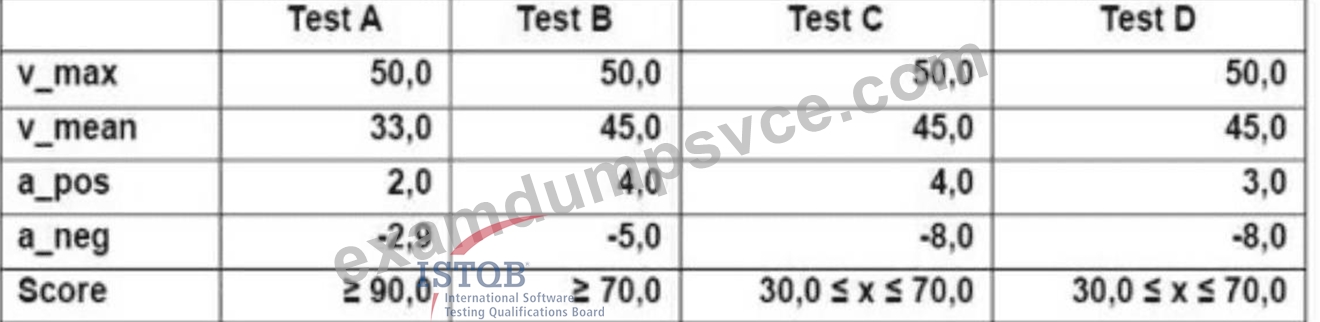
Which of the new tests is NOT a follow-up test case for metamorphic testing?
Choose ONE option! (1 out of 4)
- A. Test D is not a follow-up test case.
- B. Test B is not a follow-up test case.
- C. Test A is not a follow-up test case.
- D. Test C is not a follow-up test case.
Answer: B
Explanation:
According to the ISTQB CT-AI syllabus,metamorphic testingworks by applyingmetamorphic relations (MRs): predictable input transformations that should lead to predictable output changes. From the initial test data, clear relations emerge for defensive driving scoring. The score increases when:
* v_mean decreases,
* a_pos decreases,
* a_neg becomes less negative,and decreases when the opposite occurs.
A valid metamorphic follow-up test must modify inputs in a direction consistent with at least one MR while keeping the expected output direction predictable.
Test Alowers v_mean compared to Test 1, with similar acceleration values. This directly satisfies the MR that lower speed # higher score.
Test Cincreases both acceleration and braking intensity compared to Test 2, making the reduced score range (30-70) consistent with more aggressive driving.
Test Dmodifies acceleration and braking magnitudes in ways consistent with Test 3's defensive-driving scoring boundaries.
Test B, however, changes multiple variables in contradictory directions:
* v_mean increases (worse)
* a_pos increases (worse)
* a_neg becomes less negative (better)
Because these changes conflict,the expected score trend becomes unpredictable, violating the premise of a metamorphic follow-up test.
ThusTest B cannot be considered a metamorphic follow-up, which makesOption Ccorrect.
NEW QUESTION # 66
......
Ultimate Guide to the CT-AI - Latest Edition Available Now: https://www.examdumpsvce.com/CT-AI-valid-exam-dumps.html
2026 Updated Verified Pass CT-AI Study Guides & Best Courses: https://drive.google.com/open?id=1P5zm8b2BQx-hGKnTNPVBkC9OknPdptNE
